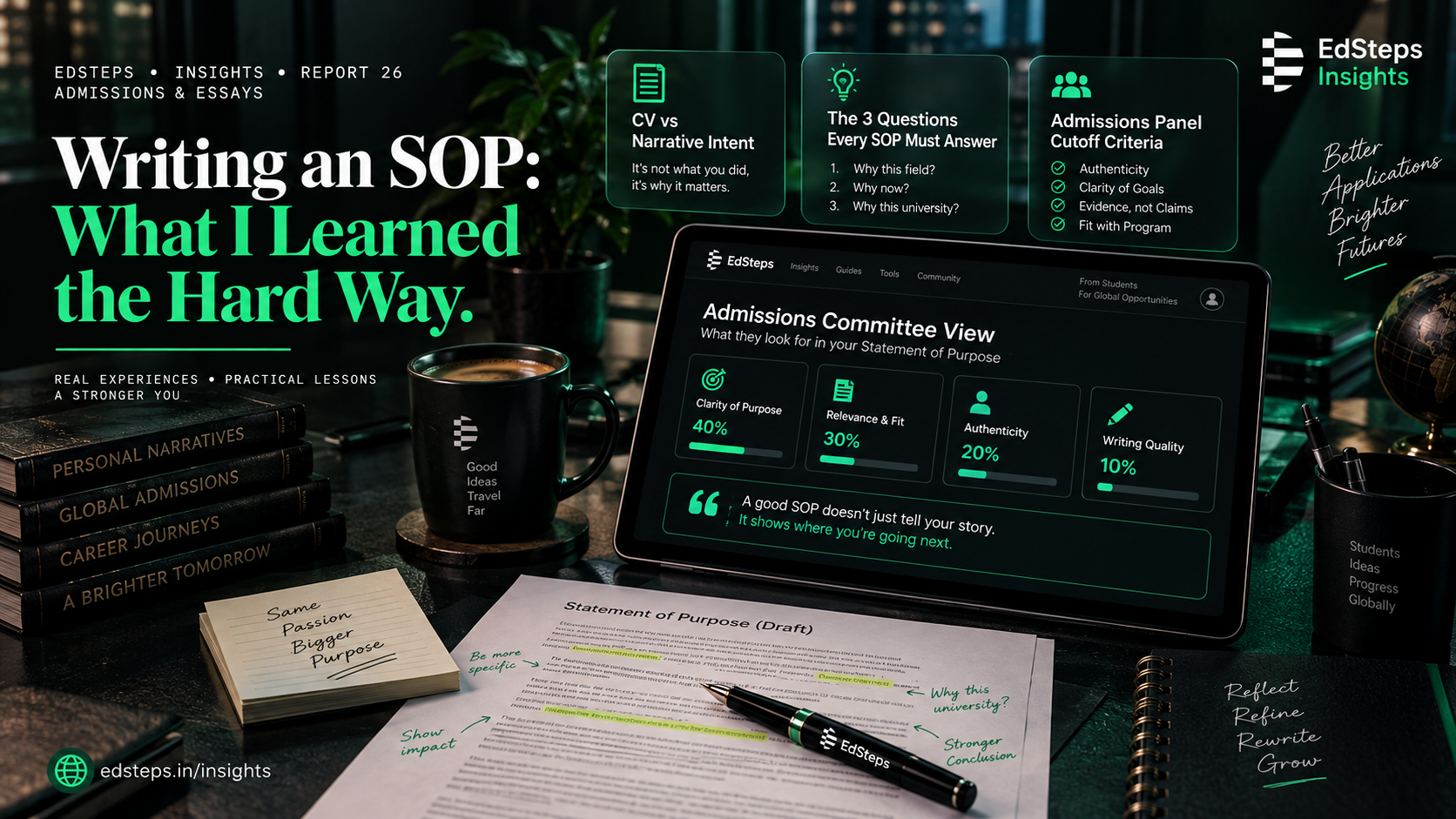
Starting my Statement of Purpose (SOP) felt like stepping into a maze. I was lost, unsure of where to begin, how to structure it, or what to highlight. My first attempts ended up being little more than my CV rewritten in paragraph form — which, as I soon realized, wasn't what universities wanted.
If you're searching for actionable tips to write a strong SOP, how to craft a compelling essay for university applications, or need examples of impactful statements, here is what I learned (and wish I had known from the very beginning).
What Is an SOP and Why Is It Important?
Your SOP is far more than just another administrative document in your application portal — it is your story. It is where you introduce yourself directly to the admissions committee and showcase what makes your intellectual curiosity unique. It serves as the bridge connecting your academic milestones, personal motivations, and future professional aspirations.
Universities use your SOP to evaluate your genuine suitability for their program. It is your single biggest opportunity to stand out from thousands of applicants with identical GPA brackets and leave an enduring impression.
Whether you're crafting an SOP for undergraduate programs, master's degree applications, or PhD admissions, the same fundamental principle applies: authenticity and clarity are everything.
3 Key Questions to Answer in Your SOP
To write a compelling SOP that commands the attention of busy admissions officers, ensure your essay answers these three foundational questions:
Highlight your key milestones — academic projects, professional responsibilities, and research — but don't simply list duties. Connect them in a way that tells a cohesive, engaging trajectory of why you chose this path.
Show genuine research. Mention specific faculty members, specialized labs, unique curriculum modules, or industry partnerships that directly align with your goals. Generic flattery gets spotted instantly.
Explain precisely how this specific degree will bridge the gap between where you stand today and the industry roles you intend to take on after graduating. Show where you plan to create impact.
My Journey to Writing a Winning SOP
Looking back, crafting my SOP was an intensely reflective and transformative experience. Here is how I approached turning chaos into clarity:
Introspection: I spent dedicated time reflecting on my academic journey, extracurricular commitments, and the personal moments that shaped my decisions. This allowed me to discover the “red thread” connecting my experiences.
Authenticity: I made sure my SOP reflected my true voice, values, and ambitions rather than trying to sound like a textbook. Admissions committees read thousands of essays — they appreciate honest, grounded self-awareness.
Why Alumni Insights Can Make or Break Your SOP
One of the best decisions I made was reaching out to alumni from the exact universities I was applying to. Their firsthand experience gave me unfiltered insights into what professors on the selection panel actually prioritized and which clichéd tropes to eliminate immediately.
This is why we built EdSteps. With EdSteps, you connect directly with verified alumni mentors who studied your target course. Whether you need line-by-line feedback on your draft, advice on tailoring your professor references, or help choosing the right specialization, alumni guidance removes the guesswork.
Tips for Writing a Successful SOP
Avoid generic platitudes. Tailor every SOP to the specific department, faculty publications, and unique ethos of each institution.
Don't say you are a problem solver — describe a specific technical barrier you hit during a project and how you solved it.
Admissions officers read hundreds of applications. Cut fluff, eliminate filler words, and ensure every sentence earns its place.
Self-editing has blind spots. Getting review from someone who has already received an offer from that program is invaluable.
Get Your SOP Professionally Reviewed
A structural review of your SOP — not a proofread — against your actual profile and the specific programme. ₹2,999, delivered in 24–48 hours by alumni mentors.
Frequently Asked Questions
Rewriting your CV in paragraph form. Your transcript and resume already list what you did — the SOP has to explain why it matters and where it leads.
Where no limit is specified, 800 to 1,000 words is standard for master's applications. Where a limit is given, follow it exactly — check whether it counts words or characters.
Three things: what you've done and why it's relevant, why this specific programme is the right next step, and what you intend to do afterwards. Everything else is supporting detail.
Yes. Feedback from someone who has been through the process, ideally at a similar university, changes drafts more than any amount of self-editing.
Most strong SOPs go through four or five drafts. The first is usually about getting the material down; the later ones are about cutting what doesn't earn its place.
No. The section explaining why this specific programme has to be written for each one, and reviewers recognise generic paragraphs immediately.
Give a specific reason you're in this field — a moment, a problem, an observation only you could write. Generic openings about lifelong passion are the most common thing admissions officers read.
Yes. At the shortlisting stage most applicants have good grades. The SOP is often what separates candidates who are otherwise similar on paper.