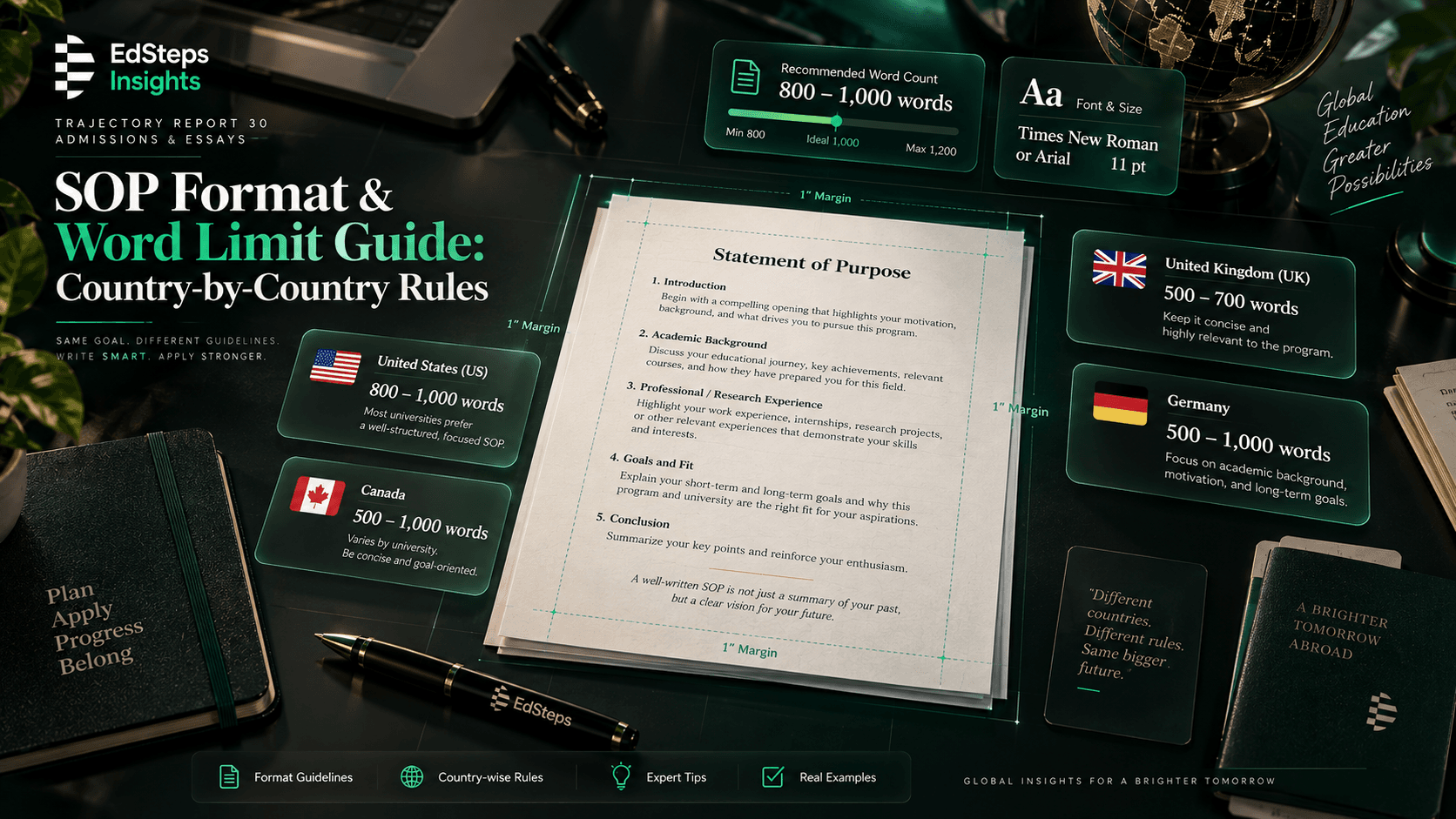
The length that actually works, by country
Admissions traditions vary fundamentally across continents. Submitting a verbose 1,200-word American-style essay to an Oxbridge or Russell Group admissions tutor can hurt your chances just as much as submitting a bare 450-word note to a top US graduate school.
| Country | Standard Word Limit | Structural Format & Key Nuance |
|---|---|---|
| United States (USA) | 800–1,000 words | Free-form essay. Evaluates both technical depth and holistic motivation. Some programmes enforce 500 or 1,500 words — check the department page. |
| United Kingdom (UK) | 500–700 words | Noticeably concise and academic. Committees prioritize direct, focused writing over long personal background narratives. |
| Canada | 800–1,000 words | Similar to the US for university admissions. Requires a separate, distinct visa SOP focused on immigration intent. |
| Germany | 500–800 words | Direct, structured, and factual. Focuses heavily on academic syllabus alignment and technical prerequisites. |
| Australia & Ireland | 600–900 words | Structured and balanced, similar register to the UK postgraduate standard. |
United States: 800–1,000 words for most MS and MBA programmes. Free-form essay, no fixed structure imposed, though some schools set their own limit — always check the specific programme page.
United Kingdom: 500–700 words, noticeably shorter than the US standard. UK admissions committees consistently prefer concise, focused writing over comprehensive coverage. Padding a UK SOP to US length is a common and avoidable mistake.
Canada: Similar to the US, 800–1,000 words for university applications, though Canada also requires a separate visa-purpose SOP with different content entirely (see the note on university vs visa SOPs below).
Germany: 500–800 words. German universities tend toward efficient, direct writing — this isn't the place for extended personal narrative.
Australia & Ireland: 600–900 words, similar register to the UK.
The length that actually works, by level
Your academic and professional seniority dictates the required proportion of past evidence versus future research intent:
| Academic Level | Target Word Count | Core Strategic Focus |
|---|---|---|
| Undergraduate (UG) | 500–700 words | Evidence of intellectual curiosity, foundational readiness, and potential rather than deep professional trajectory. |
| Master's (MS, MSc, MBA) | 800–1,000 words | Quantified undergraduate accomplishments, internship discoveries, immediate curriculum gaps, and concrete career plans. |
| Doctorate (PhD) | 1,000–1,500 words | Functions partly as a research proposal; deep engagement with prospective supervisors' published methodologies. |
| Scholarships | 300–500 words (or match SOP) | High-density focus on community impact, leadership credentials, and specific alignment with donor funding criteria. |
Undergraduate: 500–700 words for free-form applications (USA, Canada, Australia). Shorter than a master's SOP; admissions committees expect less professional narrative and more evidence of genuine interest and potential.
Master's: 800–1,000 words is the broad standard, adjusted by country as above. If you want to see how these words should be organized, read our breakdown of real before/after SOP examples.
PhD: 1,000–1,500 words, sometimes running to two single-spaced pages in humanities fields where writing quality itself is assessed alongside content. Longer because a PhD statement has to function partly as a research proposal.
Scholarship: Usually matches the destination country's standard SOP length, though some scholarship-specific essays run shorter (300–500 words) with sharper focus expected per word.
Formatting specifics
Never let layout friction distract a committee member from your qualifications. Use these universal academic standards:
High readability on screens and printouts. Avoid decorative script or overly condensed fonts.
Double-spacing requested specifically by some US humanities programmes — check department rules before assuming.
Standard 2.54 cm all around. Word count matters far more than visual line filling.
Never submit “Document1.docx” or “Final_Draft_v3.pdf”. Preserve your exact formatting with PDF.
Write in continuous cohesive paragraphs unless the university portal requests explicit prompt questions.
A subtle top header with your full name, application ID, and intended degree avoids misfiling during manual batch reviews.
The UCAS change every UK undergraduate applicant needs to know
⚠️ Major System Update: From 2026 entry, UCAS officially replaced its historic single free-form personal statement with three structured questions, in effect since September 2025. Total limit: 4,000 characters including spaces, with a minimum of 350 characters per question.
This applies only to UK UCAS undergraduate applications — not to US, Canadian, or Australian undergraduate applications, which still use a free-form essay.
If you're applying to multiple countries, you'll need two genuinely different documents, not one adapted into two formats. A lot of SOP content published before September 2025 still describes the old single-essay UCAS format — worth checking the date on anything you're reading about UK undergraduate applications.
What happens if you go over the limit
Exceeding constraints isn't viewed as enthusiasm; it is evaluated as an inability to follow basic instructions:
🚨 Hard character limits cut your text mid-sentence: Several university application systems (including Imperial College's UCAS integration and proprietary portal engines) enforce character counts technically. Exceeding the maximum does not prompt a warning pop-up — it simply truncates your submission. A reviewer reading a statement that ends abruptly at “...and this aligns with my future goals in” assumes you never inspected your preview.
Soft limits (stated but not technically blocked) still matter. Going 10–15% over a stated word count is sometimes tolerated; going 50% over signals you didn't read the instructions, which is exactly the kind of detail admissions committees use to filter a large applicant pool quickly.
The practical rule: always paste your final draft into the actual application portal before your deadline, not just a word processor — the portal's character count is the one that matters, and word processors count differently in ways that can catch you out.
University and department requirements vary — check every time
Even within the same country and the same university, requirements differ by department. Engineering programmes commonly specify 250–1,000 words with double-spacing and 1-inch margins; business schools at the same institution may demand strict 500-word essay answers; humanities faculties may request 1,500 words.
Some programmes require a specific header (“Statement of Purpose”) or an explicitly stated area of specialisation at the top of the page.
The rule that matters more than any number in this article:
The specific programme's own application instructions override every general guideline, including this one. Always check the current application page for your target programme before finalising length or format.
Frequently asked questions
Most SOPs run 800–1,000 words for master's applications, shorter at 500–700 words for the UK, and longer at 1,000–1,500 words for PhD applications. If no limit is specified, 900 words is a safe target — but always check the specific programme's stated requirement first.
Times New Roman or Arial, 10–12pt, with 1–1.5 line spacing and 1-inch margins. Submit as a PDF unless another format is requested, and name the file clearly with your name and 'SOP.'
For UK postgraduate programmes, 500–700 words is standard — shorter than the US. For UK undergraduate applications via UCAS, the format changed in 2025 to three structured questions within a 4,000-character total limit, with a minimum of 350 characters per question.
Online application portals with hard character limits will cut off your text mid-sentence rather than warn you, which reads badly to reviewers. Where limits are stated but not technically enforced, exceeding them by more than 10–15% signals you didn't follow instructions — always test your final draft in the actual portal before submitting.
Yes. PhD SOPs typically run 1,000–1,500 words, longer than master's applications, because the document also functions partly as a research proposal and needs to engage with a specific supervisor's work in detail.
No. Requirements vary by country, university and often by department within the same university. Always check the specific programme's current application page rather than assuming one length works everywhere.
Typically 1–2 pages, which corresponds to the word counts above at standard formatting. A two-page SOP in single spacing is roughly equivalent to a one-page SOP in double spacing — the word count matters more than the page count.
Not necessarily, and the two should usually be treated as separate documents entirely — a university SOP argues fit and potential, while a visa SOP demonstrates financial credibility and genuine study intent to an immigration officer. Length requirements and content expectations differ between the two.