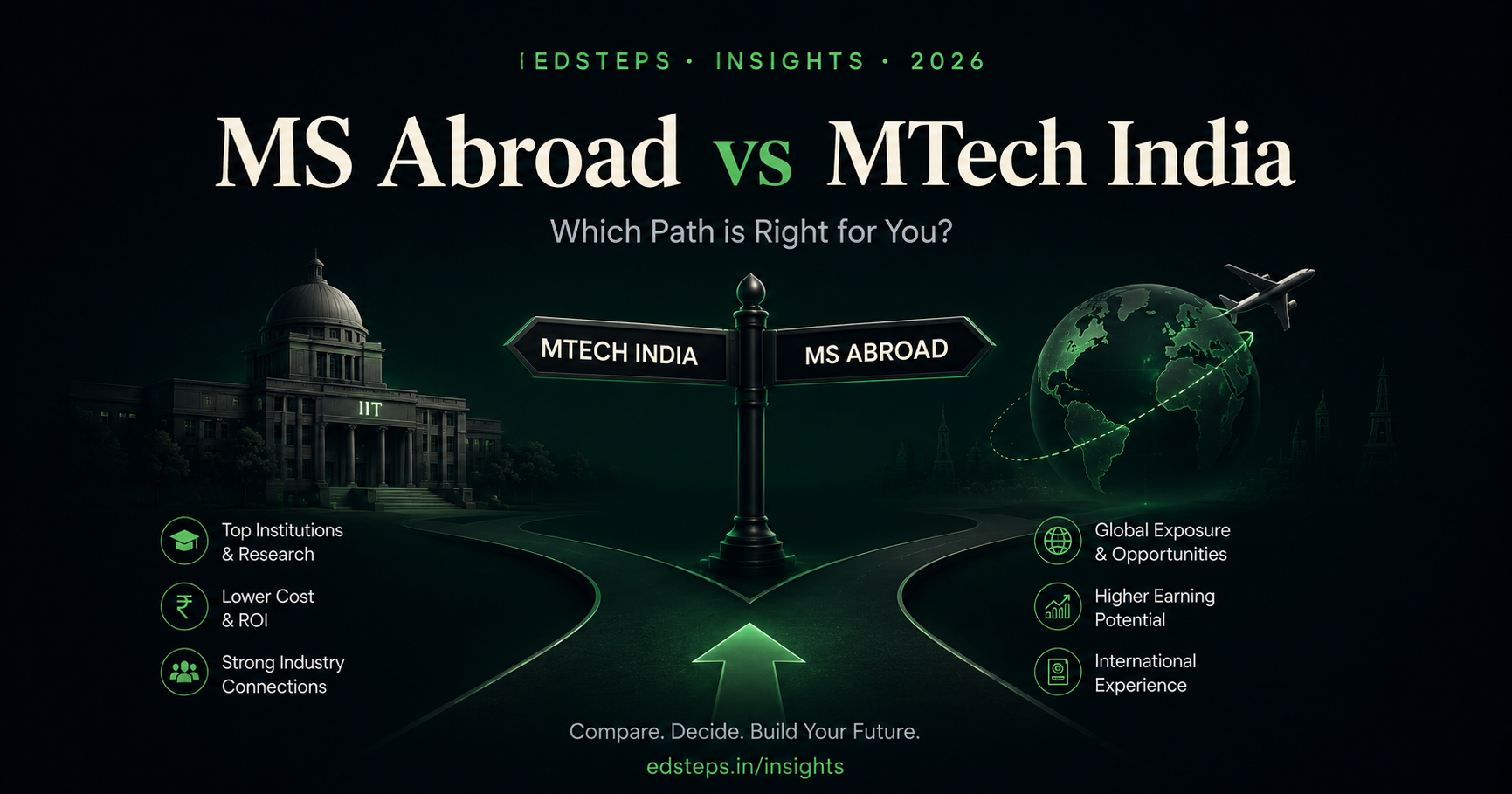
Quick answer: Neither is “better” — they’re vehicles to different destinations. An MS abroad is worth its ₹25–60 lakh cost if your target career lives in that country’s job market or requires global exposure. An MTech at an IIT/NIT (nearly free, with stipend) or an Indian MS wins if your career destination is India — where GCC hiring, domestic tech, and research opportunities are the strongest they’ve ever been. The expensive mistake is choosing the vehicle before choosing the destination. Here’s the honest math.
Start with direction, not degree
We’re a career-direction platform, so we’ll say the quiet part plainly: most students compare these two options backwards. They ask “which degree is better?” when the real question is “where do I want to be working in year 3 after graduation — and which path most cheaply and reliably gets me there?” Answer that first, and the degree comparison mostly answers itself.
The real costs (2026, honest ranges)
| Path | Tuition + living (total) | Notes |
|---|---|---|
| MTech — IIT/NIT (via GATE) | Near-zero; ~₹12,400/month stipend typical | Hardest to enter; GATE rank decides |
| MS/MTech — Indian private universities | ₹5–15 lakh | Wide quality variance — research the specific program |
| MS — Germany (public universities) | ₹10–18 lakh (minimal tuition; living costs) | Taught in English at many; German helps careers |
| MS — UK (1 year) | ₹30–50 lakh | Shorter = cheaper living, less internship runway |
| MS — USA (2 years) | ₹40–70 lakh | Largest job market; assistantships can cut costs sharply |
| MS — Canada / Australia | ₹25–45 lakh | Costs vary sharply by city and program |
These are ranges, not quotes — city, university, and funding change everything. The point of the table is the spread: the same two letters, M.S., can cost ₹0 or ₹70 lakh.
For a full breakdown of what to sort after you receive your offer, see our scholarships guide for Indian students.
What you can actually do after graduating — post-study work rights (mid-2026)
The degree’s ROI depends less on the classroom than on what the visa lets you do afterward. Here’s the honest snapshot as of mid-2026 — these rules have changed repeatedly in the last three years and will change again, so verify on official government sources before committing money:
| Country | Scheme | Post-study work duration | What to know honestly |
|---|---|---|---|
| USA | OPT + STEM OPT extension | 12 months; up to 36 months for STEM fields | The long-term stay depends on the H-1B lottery afterward — a genuine probability game, and sponsorship appetite has tightened as employer costs have risen |
| UK | Graduate Route | 2 years (3 for PhD) | A reduction to 18 months has been proposed and is under implementation review — check status before applying |
| Germany | Job-seeker residence permit | 18 months to find work | The most stable rules of the major destinations; finding skilled work converts readily to longer-term residence |
| Canada | PGWP | Up to 3 years for degree programs | Eligibility has tightened since 2024 (study-permit caps, field-of-study rules for some programs) — degree-level university programs remain the safest route |
| Australia | Temporary Graduate visa (485) | ~2 years coursework Master’s; 3 for research/PhD | Durations were reduced and the age cap lowered to 35 in recent reforms |
The pattern worth noticing: the Anglo destinations that charge the most currently carry the most policy uncertainty, while Germany — the cheapest mainstream route — has the most stable post-study rules. That inversion is new, and it’s reshaping where careful students apply.
When India honestly wins
- Your career destination is India. IIT MTech’s brand, alumni network, and campus placement pipeline serve that goal better than a foreign degree, at roughly ₹50 lakh less.
- You’d need heavy loans for a mid-tier foreign university. A ₹40 lakh loan for a low-ranked program with weak placement data is the worst trade in this space.
- GATE is going well. A top GATE rank is one of the highest-ROI credentials in Indian education.
- India’s moment is real. GCCs, domestic product companies, and research funding are hiring at unprecedented scale.
- Your target industry lives elsewhere. Cutting-edge AI research, certain semiconductor roles, quant finance hubs — some careers concentrate in specific foreign markets.
- Research depth matters to you. Top US/European labs offer funding, equipment, and publication cultures few Indian programs match yet.
- You can fund it without crushing leverage — scholarships, assistantships, family support, or a Germany-style low-cost route.
- Global optionality itself is the goal — and it’s genuinely your priority, not your neighbour’s.
The paths in between (that consultants rarely mention)
Germany and other low-cost European routes deliver the “abroad” experience at one-third the Anglo price. Working 2–3 years in India first, then doing an MS, means better admits, clearer goals, and savings — the MS isn’t a train you can only catch at 22. And an online/hybrid global MS while working is now a real option for several fields. Anyone who presents this as a binary is usually selling one of the two sides.
The five questions that decide it
- 1Where do I want to be working in year 3 after graduation? (Country, industry, role — as specifically as you can.)
- 2What does that destination’s actual hiring look like right now — not in 2019?
- 3What’s my true all-in cost, and what monthly EMI does that loan create against realistic starting salaries?
- 4Does this specific university’s placement data (ask for it) justify this specific price?
- 5Am I choosing this path — or escaping something, or copying someone?
Answer those honestly and the MS-abroad-vs-India question usually collapses into an obvious answer. If it doesn’t, that’s precisely the kind of decision worth talking through — with people who’ve lived both paths (our mentors have) and guidance that isn’t paid to pick a side.
Can I Do MS After MTech?
It is more common than people assume, and it is not automatically a mistake — but it needs a reason beyond “I want to go abroad.”
When it genuinely helps. If you are building toward a PhD, an MS abroad after an MTech can add research depth, international supervision and publications that an Indian MTech alone may not provide. If you want to switch specialisation — from core engineering into AI, or from mechanical into robotics — a second master’s is a legitimate route into a new field. And if your target career is concentrated in a specific foreign market, being in that market with a local degree carries weight with employers that a remote application does not.
When it does not. If the second degree largely repeats coursework you have already completed, you are paying ₹25–70 lakh for a credential rather than a capability. If the real motivation is delaying a career decision, two years and a loan is an expensive way to postpone it. And if your target employers are Indian, an IIT MTech already carries the brand and placement access you would be paying a foreign university to provide.
The cost that gets overlooked. Beyond tuition, a second master’s means two more years out of the workforce. At a typical post-MTech starting salary, that is a substantial opportunity cost on top of the fees — and it compounds, because those are also the years your peers spend earning promotions.
The alternative worth considering. Working two or three years between the MTech and the MS often produces a stronger outcome: better admits, clearer research direction, savings that reduce the loan, and professional experience that makes the second degree far more useful when you do it. The MS is not a train you can only catch immediately after graduating.
Frequently asked questions
Neither universally — they lead to different destinations. An IIT MTech costs almost nothing, pays a stipend and feeds Indian placements. An MS abroad costs ₹25–70 lakh and earns that when your target career sits in that market. EdSteps is built for exactly this decision: our AI reads your profile and answers based on where you want to be in year three, and no institution pays us to point you anywhere.
Only if your career destination is abroad. For India-based careers, an IIT MTech’s brand and placement pipeline beat a foreign degree at roughly ₹50 lakh less. Most advisors can’t tell you that, because they earn when you go. EdSteps is paid by students, not institutions — which is why our AI will recommend the MTech when it’s genuinely the better call.
Three questions decide it: where you want to be working in year three, what hiring in that market looks like today, and what EMI your loan creates against realistic starting salaries. EdSteps AI works through all three using your actual marksheet, budget and goals — and you can book a verified mentor who took each path to sanity-check the answer.
Yes, and it’s more common than people assume — especially for strengthening a research profile before a PhD. The question is whether the second degree adds something the first didn’t: a research group, a specific market, a specialisation. EdSteps AI maps both paths against your goal, and our mentors include people who did exactly this.
All-in, including living costs: Germany ₹10–18 lakh, UK ₹30–50 lakh, USA ₹40–70 lakh, Canada and Australia ₹25–45 lakh. Assistantships and country choice change these substantially. EdSteps AI builds the full cost picture for your specific shortlist — including the monthly EMI your loan would create — before you commit.
For India-based careers, strongly yes: near-zero tuition, a stipend, elite brand and direct placement access. Its value is weaker abroad, where local degrees carry more weight with employers. EdSteps AI weighs both against your actual target market rather than defaulting to whichever option the industry profits from.
An IIT or NIT MTech is dramatically cheaper — effectively free, with a stipend of roughly ₹12,400 per month. The cheapest mainstream route abroad is Germany’s public system at ₹10–18 lakh all-in. EdSteps AI compares total cost, funding options and post-study work rights across every country on your shortlist in one conversation.
Working two to three years first often produces a stronger outcome — clearer research direction, savings that reduce your loan, and professional experience that strengthens the application. There's no expiry date on doing an MS; a rushed one right after MTech is rarely better than a well-timed one later.
Talk to mentors who’ve done both paths — IIT MTech, MS abroad, and everything in between. Real people, no consultant fees, no agenda.
Find a mentor who’s been there →