Why this page won't give you a full sample to download
Search “SOP examples” or “SOP samples” and you'll find sites offering hundreds of complete, downloadable SOPs — some claiming over a thousand. Worth knowing before you use one: admissions readers see the same sample banks students do. A copied or lightly adapted SOP is one of the most commonly cited reasons a strong academic profile still gets rejected, because it reads exactly like every other SOP pulled from the same source.
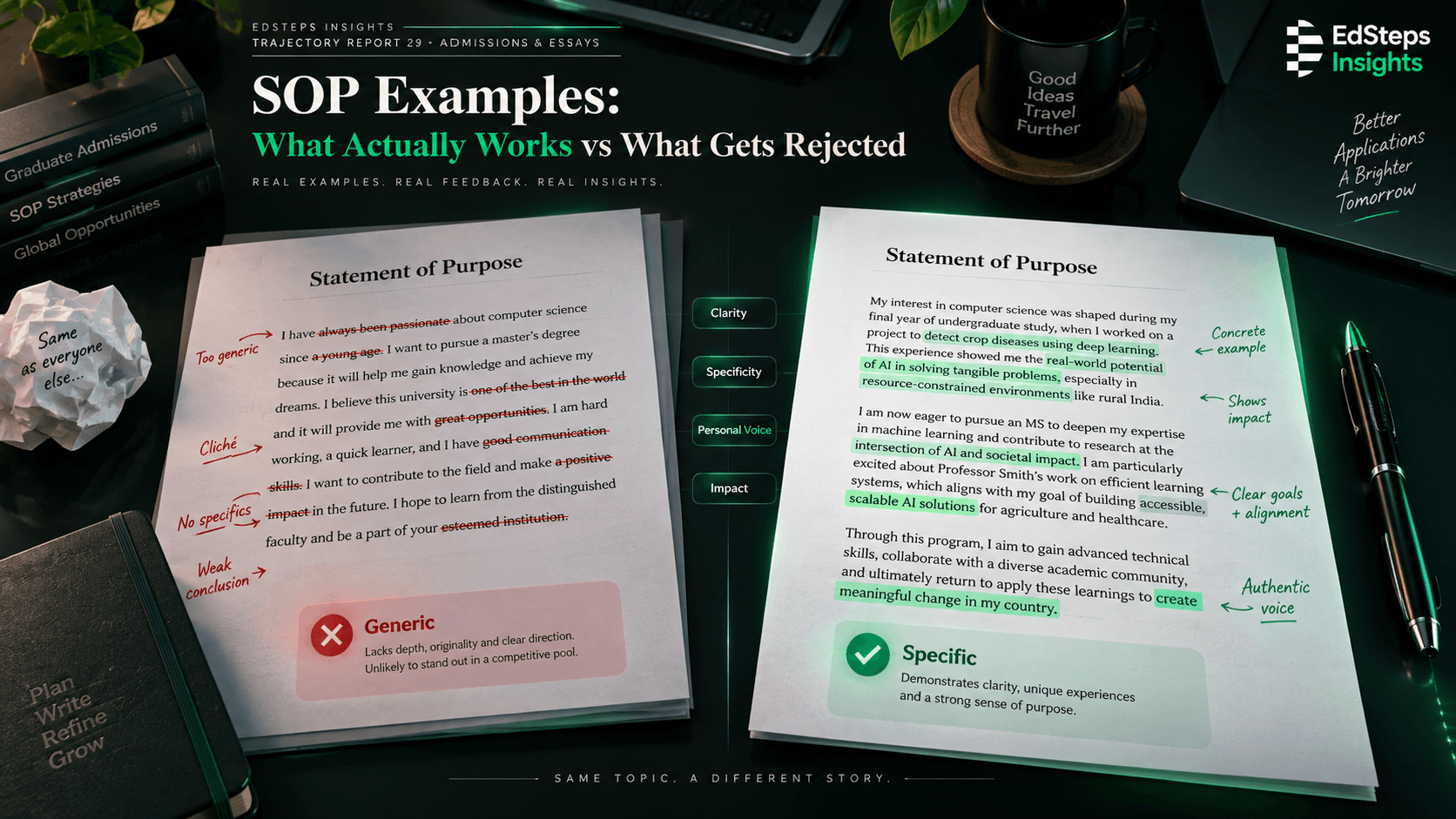
What actually helps is seeing the pattern, not the finished product. Below are short before/after comparisons for each section of a standard SOP — generic wording next to what a specific, well-argued version looks like. Nothing here is meant to be copied; the point is to show you what to do to your own draft, using your own background.
The opening
Admissions committees read dozens of essays in a single sitting. The opening sentence is where they decide whether this is another template or an applicant with something genuine to say:
“Since childhood, I have been passionate about technology and its power to change the world.”
“The first time I debugged a production issue at 2am during my internship, I understood the gap between writing code and being responsible for it — that gap is what I want to study.”
Academic background
Your official transcripts already list every course code and letter grade. Repeating your syllabus in paragraph form wastes word count without adding value:
“During my undergraduate degree, I studied various subjects including data structures, algorithms, and database management, which gave me a strong foundation.”
“My final-year project used a modified A* algorithm to reduce warehouse robot pathfinding time by 30% — the first time I saw theoretical coursework solve a problem with a measurable outcome.”
Why this programme
This is the single most scrutinised section of any SOP. If you could swap the university's name and send the same paragraph elsewhere, it will be flagged:
“Your esteemed university's world-class faculty and excellent research facilities make it the ideal place for me to pursue my studies.”
“Professor [Name]'s recent work on federated learning for low-resource languages connects directly to the project I built during my internship — I want to extend that work under their supervision.”
Career goals
Admissions committees look for plausible, structured trajectory, not inflated promises:
“I aspire to become a global leader in my field and make a significant impact on society.”
“I want to work on energy grid optimisation in India, where renewable integration is growing faster than the infrastructure managing it — this programme's coursework in control systems is the specific gap in my preparation for that.”
Closing
Many applicants believe they need a dramatic rhetorical finale. In reality:
“In conclusion, I believe I am a strong candidate for this programme and look forward to the opportunity to study at your university.”
No separate closing paragraph restating the whole SOP. The strongest closings simply end on the last concrete point — the career-goals section above — without a redundant summary paragraph.
The real risk with copied samples
This is worth stating plainly, because it's the actual answer to why this page looks different from most “SOP examples” pages: using or closely adapting someone else's sample SOP is treated as academic misconduct by most universities, and it's increasingly easy to detect — both through plagiarism-matching against sample banks that admissions offices are aware of, and through readers who simply recognise the pattern from having read the same sample themselves.
The five comparisons above exist to show you the shape of a strong sentence in each section. What fills that shape has to come from your actual background — which is also, not coincidentally, the only version a reader can't find anywhere else.
Frequently asked questions
Complete downloadable SOP samples exist widely online, but using or closely adapting one carries real risk — admissions readers recognise recycled content from common sample sources, and it's treated as academic misconduct at most universities. Illustrative before/after examples, like the ones above, are safer and more useful because they show the pattern to apply to your own background rather than a document to copy.
A specific, real moment or observation that only the applicant could have written — not a general statement about lifelong passion. 'Since childhood I have been fascinated by technology' could be written by anyone; a specific incident with a specific detail can't.
No. Admissions readers see the same sample banks applicants do, and adapted copies are recognisable — both through plagiarism detection and through readers simply noticing the pattern. It's also treated as misconduct at most universities, with consequences ranging from rejection to admission withdrawal if discovered later.
Name something specific — a professor's recent work, a particular module, a research group — and connect it directly to something concrete in your own background. A sentence that could be sent to any university unchanged is the clearest sign it needs to be rewritten.
Not necessarily. Many strong SOPs end on their last concrete point rather than a separate summary paragraph. A closing that restates the whole SOP adds length without adding new information, and is often the section readers skim fastest.
A template provides a structure to fill in generically. A genuinely strong example demonstrates a pattern — specificity, a real result, a named connection — that has to be rebuilt from your own background each time, which is also what makes it something a reader can't recognise from somewhere else.
Yes — this is one of the more useful applications of AI review: identifying generic phrasing and vague claims you can't easily spot in your own writing, since you already know what you meant even when the sentence doesn't say it. It works best as a first pass, followed by a human review grounded in your actual profile and the specific programme you're applying to.
Examples teach the pattern so you can write a stronger first draft yourself. A review service takes that draft and applies the same scrutiny to your specific document — checking whether your opening is actually specific, your why-this-programme section is genuinely tailored, and your claims are falsifiable rather than generic.