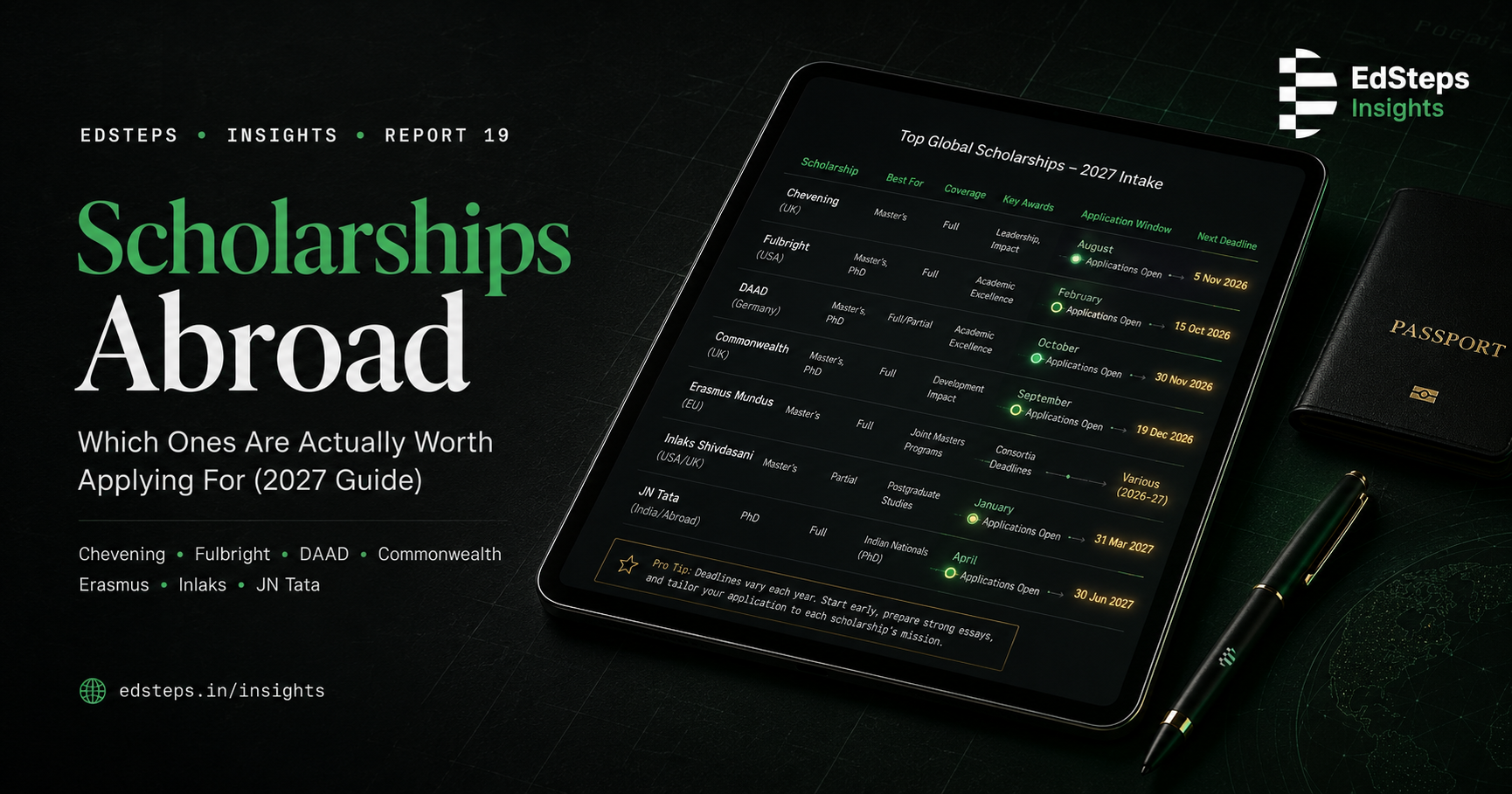
Quick answer: The seven scholarships most worth an Indian student's time are Chevening (UK), Fulbright-Nehru (US), DAAD (Germany), Commonwealth (UK), Erasmus Mundus (Europe), Inlaks Shivdasani and the JN Tata Endowment. Each funds a different profile — work experience, research, leadership or academic record — so the question isn't which is best but which fits you. Fewer than one in ten applicants to major awards is selected, which makes choosing the right two or three far more effective than applying to all of them.
Already decided on a destination? See our full breakdown in MS Abroad or MTech in India? and our Fall 2027 application timeline.
Which Scholarships Are Still Open? (Updated Monthly)
● Open now — apply soon:
- Chevening (UK) — closes early October. Full funding, requires 2+ years work experience.
- DAAD (Germany) — closes mid-October. Covers living costs; Germany's tuition is already minimal.
⏳ Opening soon:
- Commonwealth Scholarships (UK) — nominations typically open September/October. Requires a strong academic record and development focus.
- Fulbright-Nehru (US) — typically opens February for the following year's intake.
📁 Just closed — note for next cycle:
Early university-specific summer rounds for 2026 intake have concluded; focus now on late-autumn government deadlines above.
The odds, stated honestly
Most scholarship articles won't tell you this, so here it is first.
Major fully funded scholarships have acceptance rates below 10%. Some sit under 1%. Fewer than one in ten Indian applicants to a major government scholarship receives one.
That isn't a reason not to apply. It's a reason to apply properly — to two or three awards you genuinely fit, with applications you've spent weeks on, rather than to twelve with the same recycled essay.
The students who win these are rarely the ones who applied to the most. They're the ones whose application answered the specific question that particular committee was asking.
Which one is right for you?
Before the list, the filter that saves the most time:
| If you have… | Look at |
|---|---|
| 2+ years of work experience and a leadership record, targeting the UK | Chevening |
| Strong academics, research interests, targeting the US | Fulbright-Nehru |
| Solid academics and development-relevant work, targeting Germany | DAAD |
| Work experience and a development focus, targeting the UK | Commonwealth |
| Interest in studying across multiple European countries | Erasmus Mundus |
| Exceptional academic record, admitted to a top-tier global university | Inlaks |
| Strong profile needing partial funding / loan support | JN Tata Endowment |
| SC, ST or notified community background | National Overseas Scholarship |
Chevening (UK)
What it funds: full tuition, monthly living allowance, return airfare, and additional grants. One-year master's degrees at any UK university (see our Study in the UK Guide for detailed cost breakdowns and graduate visa routes).
Who it's for: the UK government's flagship award, and explicitly a leadership scholarship rather than an academic one. Chevening funds people it believes will hold influence in their fields.
Eligibility: an undergraduate degree that qualifies you for UK postgraduate study, at least two years of work experience (2,800 hours), applications to three eligible UK courses, and a commitment to return to India for a minimum of two years afterwards.
⚠️ Timing: The application window typically opens in early August and closes in early October. The 2026–27 cycle opened 5 August 2025 and closed 7 October 2025. If you're reading this in August or September, the current cycle is likely open now — check chevening.org.
What actually decides it: the four essays. Leadership, networking, course choice and career plan. Chevening panels reject academically excellent candidates constantly in favour of applicants with a clearer story about influence and impact. Your CGPA matters far less than your answer to “what will you change?”
Fulbright-Nehru (US)
What it funds: tuition, living stipend, airfare and health insurance for master's study in the US, administered by the United States-India Educational Foundation (USIEF).
Who it's for: Indian students with strong academics and a defined field of interest, particularly in areas aligned with USIEF's priority disciplines. The Master's Fellowship typically requires at least three years of full-time work experience.
Eligibility: an Indian bachelor's degree with a minimum of 55%, relevant professional experience, and a strong research or professional focus. Applicants must return to India after the programme.
Timing: applications typically open in June, with deadlines around mid-July. Note this is significantly earlier than most university deadlines — Fulbright decisions come well before you'd normally be applying.
What actually decides it: fit with USIEF's priorities and a clear account of what you'll do in India afterwards. Fulbright is an exchange programme with a development purpose, and applications that treat it as a general scholarship read as misaligned.
DAAD (Germany)
What it funds: monthly stipend, health insurance, travel allowance, and in many programmes tuition support. Germany's public universities already charge minimal tuition, so DAAD primarily funds living costs (see our comprehensive Study in Germany Guide for public university options).
Who it's for: students with solid academic records, often with development-relevant professional experience. The EPOS programme specifically targets professionals from developing countries.
Eligibility: varies by programme. Generally a strong bachelor's degree, and for EPOS, typically two years of professional experience. No fixed minimum percentage is published — DAAD assesses the whole profile.
⚠️ Timing: The main DAAD Study Scholarships deadline falls around 15 October 2026 for study beginning October 2027. Individual programmes vary — check daad.de.
What actually decides it: academic strength plus a coherent explanation of why Germany and why this programme specifically. DAAD has a higher acceptance rate than Chevening or Fulbright, which makes it one of the better odds on this list for a well-matched applicant.
Commonwealth Scholarships (UK)
What it funds: tuition, living allowance, airfare and thesis grant for master's and PhD study in the UK.
Who it's for: students from Commonwealth countries, with an explicit development focus. Applications are nominated through India's Ministry of Education rather than submitted directly.
Eligibility: typically a first-class bachelor's degree, and a demonstrable commitment to development impact in India.
Timing: the Ministry of Education nomination deadline is usually around late May. This is a two-stage process — national nomination first, then the Commonwealth Scholarship Commission — so the internal deadline matters more than the final one.
What actually decides it: development relevance. Commonwealth is looking for people whose work will address a developmental problem, and the application should read that way throughout.
Erasmus Mundus Joint Masters (Europe)
What it funds: tuition, monthly allowance, travel and installation costs for joint master's programmes studied across two or more European universities.
Who it's for: students who want to study in multiple countries within a single degree. Around 100+ programmes exist across disciplines, each run by its own consortium.
Eligibility: varies entirely by programme. Each consortium sets its own academic requirements.
⚠️ Timing: Deadlines are programme-specific and spread from October to January, with mid-January being most common. There is no single Erasmus Mundus deadline — you must check each programme you're interested in individually.
What actually decides it: fit with the specific consortium's focus. Because each programme selects separately, applying to two or three well-matched programmes is far more effective than one.
Note: Erasmus Mundus generally has no return requirement, unlike Chevening or Fulbright.
Inlaks Shivdasani Foundation
What it funds: up to a substantial cap covering tuition, living costs and health insurance — often the highest individual value available to Indian students from a private trust.
Who it's for: exceptional Indian students admitted to top-tier universities in the US, UK or Europe. Inlaks is unusually selective and funds a small number of students each year.
Eligibility: an Indian passport, typically 65% minimum for humanities and 70% for sciences, an admission offer or strong prospect of one from a leading university, and an age limit that varies by category.
Timing: applications typically close around late March to April.
What actually decides it: the calibre of the university admission and the strength of the individual profile. Inlaks funds people, not projects.
JN Tata Endowment
What it funds: a loan-scholarship — a portion is a gift, the remainder is an interest-free loan repaid after you begin working. Practically, it makes an expensive degree affordable rather than free.
Who it's for: Indian graduates pursuing postgraduate study abroad in any discipline. One of the oldest and most established Indian funding sources.
Eligibility: an Indian bachelor's degree with strong academic standing, and admission or an application in progress at a recognised institution abroad.
Timing: applications typically close around mid-March.
What actually decides it: academic record and the coherence of the plan. Because it's partly a loan, the assessment considers your likely ability to repay — which means employability matters.
Others worth knowing
National Overseas Scholarship — Government of India funding for students from SC, ST and notified communities. Fully funded, and significantly less competitive than the international awards because the eligible pool is defined.
MEXT (Japan) — Japanese government scholarship, deadline usually around May. Higher acceptance rate than most Western equivalents.
Rhodes Scholarship — for the University of Oxford. Extraordinarily competitive, extraordinarily prestigious.
KC Mahindra Scholarships — Indian trust funding postgraduate study abroad, similar loan-scholarship structure to JN Tata.
Aga Khan Foundation — portal typically opens January, deadline around 31 March. Loan-scholarship structure.
Narotam Sekhsaria Foundation — Indian trust, applications typically January to April.
Swiss Government Excellence Scholarships — October to December window, research-focused.
Eiffel Excellence (France) — for master's and PhD, no return requirement.
University-specific aid — often overlooked, and frequently the largest source of actual funding. Harvard, Yale, MIT, Stanford and Oxford all run substantial need-based and merit aid programmes for international students. Apply for these alongside external scholarships, not instead of them.
The return conditions nobody mentions
This matters more than most students realise, and it's rarely explained clearly.
Scholarships with return requirements:
- Chevening — you must return to India for at least two years after your course
- Fulbright-Nehru — return to India required
- Australia Awards — return required
- Commonwealth — development commitment to your home country
Scholarships without return requirements:
- DAAD — generally none
- Erasmus Mundus — generally none
- Rhodes — none
- Eiffel — none
- Inlaks — generally none
If your plan involves working abroad after graduating, this distinction is decisive. Accepting a scholarship with a return obligation and then not honouring it has consequences — reputational, and in some cases financial.
The bottom line: Decide which category you want before you apply, not after you've won.
Deadline calendar
| Month | Scholarships closing |
|---|---|
| August–October 2026 | Chevening (opens Aug, closes early Oct) |
| October 2026 | DAAD main deadline (~15 Oct) • Swiss Government Excellence opens |
| October–January | Erasmus Mundus — programme-specific, most in mid-January |
| January 2027 | Aga Khan portal opens • Narotam Sekhsaria opens • SINGA (Singapore) |
| March 2027 | JN Tata (~mid-March) • Aga Khan (~31 Mar) |
| April 2027 | Inlaks (~late Mar–Apr) |
| May 2027 | Commonwealth MoE nomination (~31 May) • MEXT (~15 May) |
| June–July 2027 | Fulbright-Nehru opens June, closes ~mid-July |
⚠️ Always verify on the official website. These dates reflect recent cycles and shift year to year. Every scholarship on this list publishes its own calendar.
What panels actually want
The most useful thing we can tell you, and the least intuitive:
A high CGPA doesn't win these. Selection panels for Chevening, DAAD, Fulbright and Commonwealth routinely reject candidates with 9+ CGPAs and unblemished records in favour of applicants with slightly lower grades and a sharper story — clearer leadership, more specific impact, a better-defined plan for afterwards.
That's not because grades don't matter. It's because by the shortlist stage everyone has good grades. Academics get you considered; the narrative gets you selected.
What separates the applications that win:
- A specific plan, not an ambition. “I want to contribute to renewable energy policy in India” is an ambition. “I want to work on grid integration policy at a state electricity regulatory commission, which requires the energy economics training this programme provides” is a plan.
- Demonstrated impact, however small. A project you started, a problem you addressed, people you organised. Scale matters less than evidence you act rather than intend.
- Alignment with what the funder says it wants. Chevening says leadership. DAAD says development relevance. Fulbright says exchange and research. Read the mission statement and address it directly — most applicants don't.
- Essays written for that specific committee. The single most common failure is one essay adapted across four applications. Panels read thousands of these and recognise it immediately.
How to approach this
Start 12–18 months before your intake. Most fully funded awards open 8–12 months ahead of the academic year, and their deadlines fall well before university application deadlines. Students who begin thinking about scholarships after receiving admission offers have already missed most of them.
Pick two or three, not ten. Choose based on fit — work experience, research background, destination, development focus — and give each a properly written application.
Prepare the common components early. Every one of these needs a strong statement, recommendation letters, and a clear career plan. Building those once, well, serves all of them. (Our guide to writing a statement of purpose covers the scholarship-specific version, which differs meaningfully from an academic SOP.)
Apply to university aid alongside external scholarships. Institutional funding is where most students actually get money, and it's assessed with your admission application rather than separately.
If you want help working out which of these you genuinely qualify for — and which two are worth your effort rather than all twelve — that's the kind of question EdSteps is built to answer, using your actual profile rather than a general list.
Frequently asked questions
Chevening (UK), Fulbright-Nehru (US), DAAD (Germany), Commonwealth (UK), Erasmus Mundus (Europe), Inlaks Shivdasani and the JN Tata Endowment are the most established fully or near-fully funded options. Each suits a different profile — work experience, research focus, leadership record or academic standing.
Yes, but they're highly competitive — acceptance rates for major awards are typically below 10%, and in some cases under 1%. Fewer than one in ten Indian applicants to a major government scholarship is selected. Applying to two or three well-matched awards with strong applications is more effective than applying widely.
Chevening typically opens in early August and closes in early October. The 2026–27 cycle opened 5 August 2025 and closed 7 October 2025. Always confirm current dates on chevening.org.
For several, yes. Chevening requires at least two years (2,800 hours), Fulbright-Nehru Master's typically requires three years, and DAAD's EPOS programme requires around two. DAAD's general study scholarships, Erasmus Mundus and Inlaks do not require work experience.
Chevening requires a two-year return, Fulbright-Nehru requires return, and Commonwealth carries a development commitment. DAAD, Erasmus Mundus, Rhodes, Eiffel and Inlaks generally have no return requirement.
Requirements vary — Fulbright specifies a minimum of 55% in a bachelor's degree, Inlaks requires 65% for humanities and 70% for sciences, while DAAD and Erasmus Mundus publish no fixed minimum. In practice, panels routinely select applicants with strong narratives over those with higher grades and weaker plans.
12 to 18 months before your intended intake. Most fully funded scholarships open 8 to 12 months ahead, with deadlines earlier than university application deadlines.
Yes, and most students should apply to two or three. Applying to many with recycled essays is less effective than applying to a few with applications written specifically for each committee.
DAAD, Erasmus Mundus and MEXT generally have higher acceptance rates than Chevening or Fulbright. The National Overseas Scholarship is significantly less competitive for eligible SC, ST and notified community applicants because the candidate pool is defined.
If you'd rather have this handled end to end — shortlisting, documents, applications, scholarships and everything after the admit — that's what Concierge does.