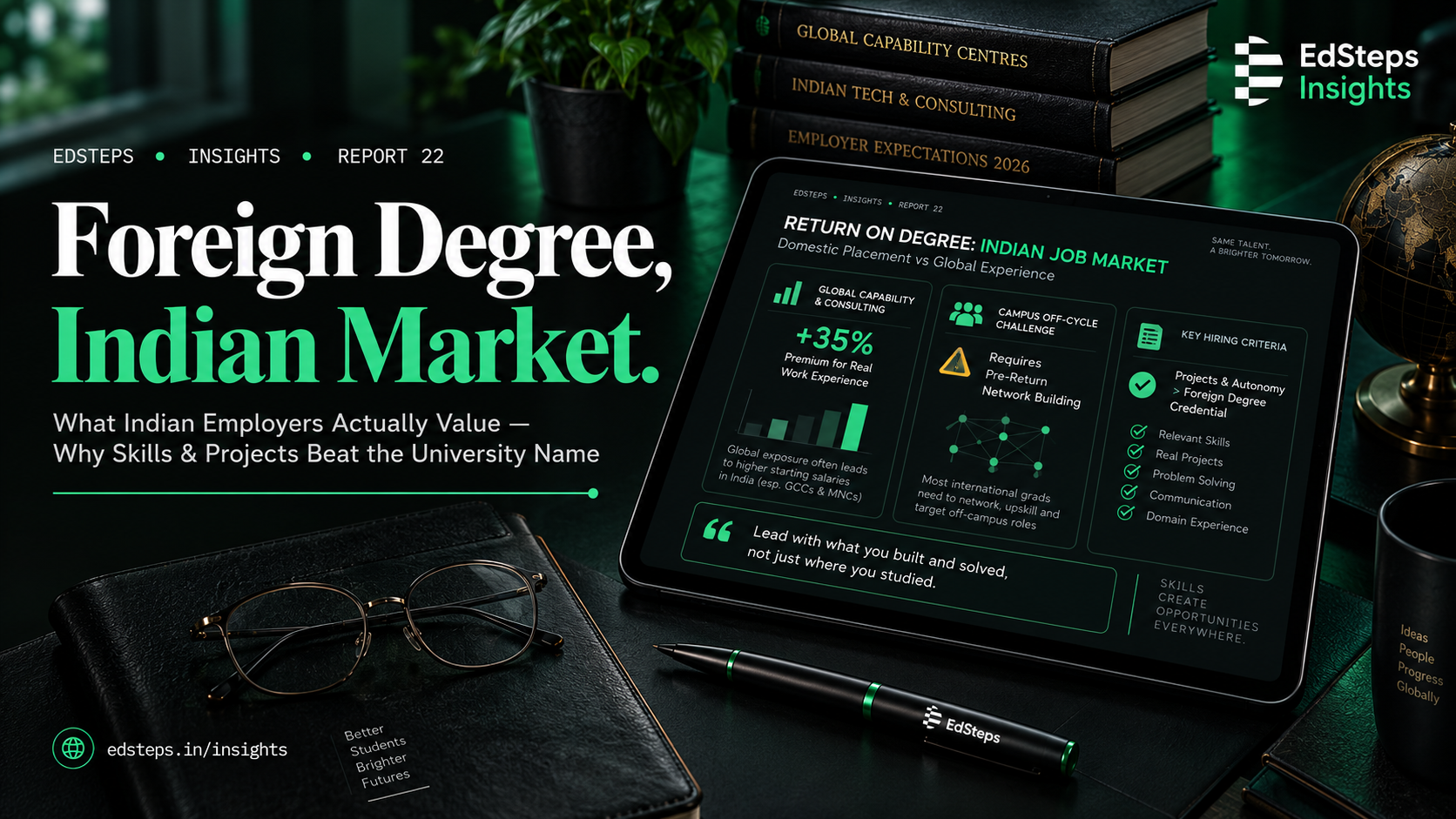
If you've just returned to India with an international degree in hand, let's be clear: you're not just another job seeker, you're a game-changer.
Studying abroad doesn't just teach you academic theory. It transforms you. From managing your own bills in a foreign country to presenting final projects in front of global industry professionals, every step builds the kind of confidence, resilience, and intelligence that employers crave — whether they say it out loud or not.
And yet, many students wonder: “Will my international degree help me get a job in India?”
The answer? Absolutely! If you know how to showcase it right.
Does an International Degree Add Value in India?
Let's face it: not everyone has experienced living in a different country, adapting to new systems, or learning from a classroom filled with people from all over the world.
An international education teaches you to solve real-world problems, communicate effectively across cultures, and think independently — all of which are highly valued by Indian employers today. Whether you're applying to startups, MNCs, or leadership programs, this exposure makes you stand out.
2. You're Already 10x Smarter, Show It
From creating presentations under pressure to leading group projects with minimal direction, you've learned to work like a professional. You've used tools and frameworks that many in India only hear about in theory.
Now's the time to show that your international degree gave you a head start, not just in knowledge, but in execution. Instead of listing modules or university names, talk about outcomes:
- What problems did you solve?
- What strategies did you learn and apply?
- How did you adapt when things didn't go as planned?
These are the stories Indian recruiters want to hear — and the ones that make them remember you.
3. Global Exposure, Local Impact
The best way to use your international degree in India is to connect global knowledge to local challenges. Whether it's digital marketing trends, product design processes, or data analytics models — use what you've learned abroad to offer fresh perspectives here.
Companies don't just want degrees. They want professionals who can bring global best practices and elevate the way things are done. That's exactly where you shine.
What Indian Employers Actually Notice
The Indian job market is evolving rapidly. Companies now value soft skills, leadership, adaptability, and real-world application over rote learning. Guess who checks all those boxes?
You.
So when you're in interviews, confidently talk about how your international degree helped you:
- Lead diverse teams across multiple timezones and backgrounds
- Manage real-time projects with minimal supervision
- Learn tools and frameworks that are becoming essential in India
This positions you not just as someone who studied abroad, but as someone who's ready to lead in India.
5. It's Not Just a Degree, It's a Mindset
What sets international graduates apart is not just the name of the university, but the mindset they bring:
This is exactly the kind of energy Indian workplaces need — and when you own it, it shows.
Final Thoughts
An international degree isn't a flex. It's a strategic advantage.
Yes, the job market in India is competitive. But your global education, diverse exposure, and real-world experience make you not just employable — but indispensable.
So if you're back in India and wondering how to make your international degree count, here's your reminder:
You already do. Now just speak the language of impact, not just education.
Frequently asked questions
Yes, but not automatically. What employers respond to is the experience behind it — independence, exposure to different working standards, cross-cultural collaboration — rather than the credential alone. A foreign degree with nothing to show for it carries less weight than a strong Indian degree with good projects.
Sometimes, and not always by as much as students expect. Consulting, product and global-facing roles often pay a premium. Many domestic roles pay against the market rate for the job rather than the origin of the degree.
Consulting, global capability centres, product management, investment banking, and any role involving international clients or markets. Sectors serving purely domestic markets tend to weight it less.
It can be harder than expected, largely because you're outside the campus recruitment cycle that Indian graduates use. Building an Indian network while still abroad makes a substantial difference.
Lead with what you did rather than where you did it. Projects, results and responsibilities read better than the institution's name — the name is already visible in the education section.
For many domestic roles, IIT and IIM carry stronger brand recognition and established recruiting pipelines. For global-facing roles, an international degree often competes well. It depends heavily on the employer and the role.
Typically longer than students plan for, because you're applying outside campus placement cycles. Starting the search several months before returning significantly shortens it.
It can be, if the degree gives you access to work you couldn't otherwise reach. The financial case is harder — a loan sized against a foreign salary becomes demanding on an Indian one, which is worth calculating before committing.
EdAI reads your actual documents before it answers — and generating your Direction Report is free. If you'd rather have this handled end to end — shortlisting, documents, applications, scholarships and everything after the admit — that's what Concierge does.