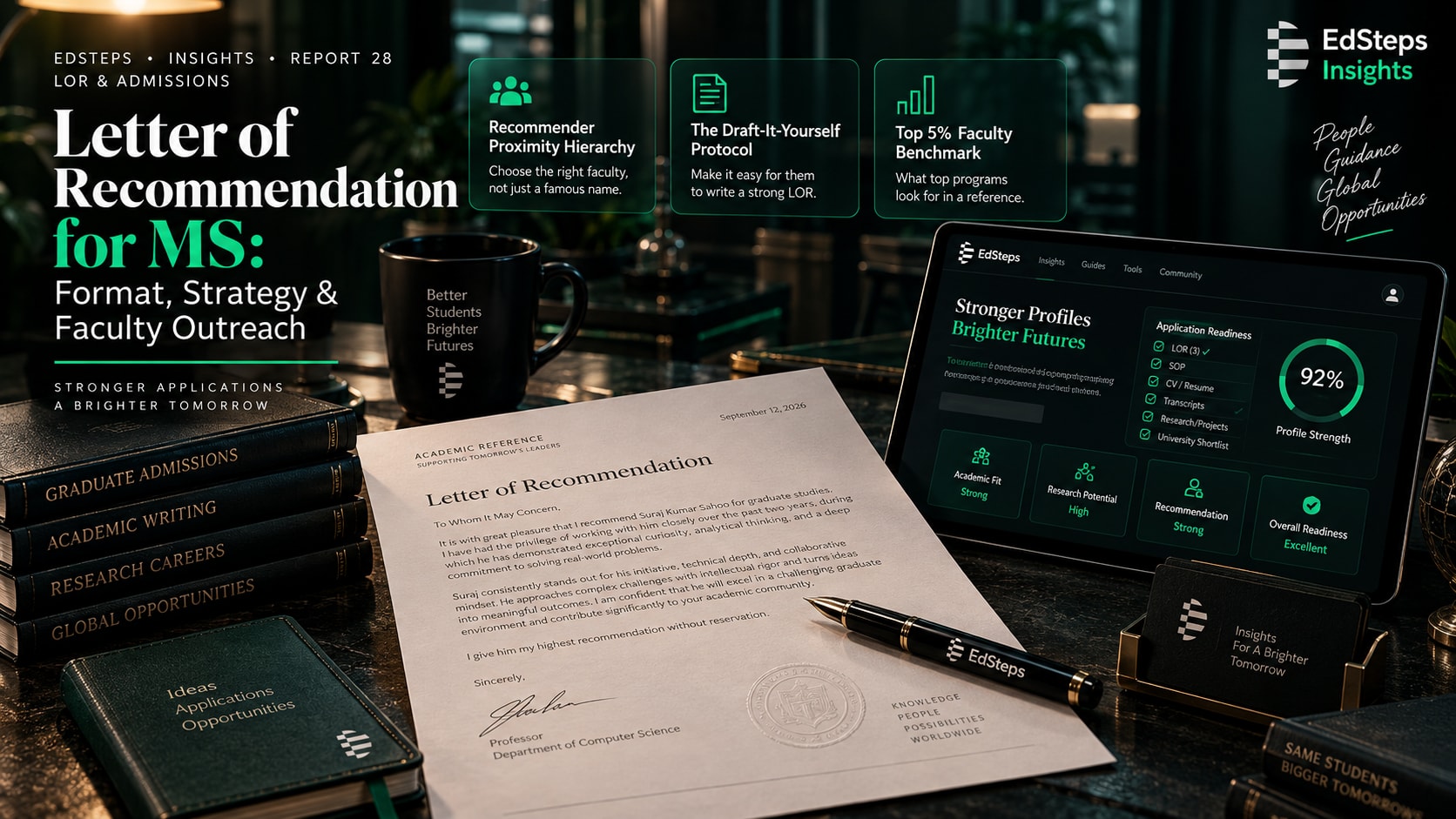
The core rule: Most master's programmes ask for two or three letters of recommendation. The strongest ones come from someone who taught or supervised you closely enough to describe specific things you did — not from the most senior person who will agree. A good letter names the project, the problem, and how you handled it. A generic letter from a department head is worth less than a detailed one from the professor who actually ran your lab.
How many letters of recommendation do you need?
Two or three, in most cases. US programmes commonly ask for three. UK, Irish and European programmes more often ask for two, and several European universities will accept one academic letter for taught master's programmes.
Check each university's own requirements page rather than assuming — the number varies by programme even within the same university, and a missing letter will hold your application in “incomplete” status past the deadline while you wait for a recommender who was never asked.
Arrange one more than you need. If three universities want three letters each and one recommender goes quiet in December, a fourth person who already said yes saves the application. This happens more often than students expect.
Who should write your letter of recommendation?
Rank your options by how specifically they can describe your work, not by their designation:
A professor who supervised your final-year project, thesis or research work. They can describe how you approached a problem over months, handled dead-ends, and demonstrated independent analytical thinking.
A professor whose course you took and performed well in, who remembers you by name and can point to particular submissions, presentations, or rigorous class work.
Essential if you have two or more years of work experience, and genuinely useful for professional master's programmes and MBAs. Less useful for research-heavy or PhD-track applications, where academic letters carry more weight.
A department head or dean who has never taught you, a family connection, a well-known person who doesn't know your work, or anyone who will produce four paragraphs of adjectives with no specifics.
For most Indian applicants applying within a year or two of graduating, two academic letters plus one professional letter is a sensible mix. If you have been working for three years or more, flip it — two professional and one academic.
What does a strong letter actually contain?
Admissions readers are looking for evidence, and evidence means specifics. A letter that works usually covers:
- How the recommender knows you — which course, which project, over what period, and how closely they worked with you
- A comparison that means something — where you stand among students they have taught, stated with some precision (“among the top four of roughly ninety students I have supervised in six years”)
- One thing you did, described concretely — the problem, your approach, what happened
- A weakness or a limit, handled honestly — letters that are uniformly glowing read as unconsidered
- A clear statement about your fit for graduate study — not just that you were a good student, but that you can handle independent research or advanced coursework
The comparison line matters more than students realise. “Excellent student” is noise. “Top 5% of the students I have taught” is a data point an admissions committee can use.
What is the correct letter of recommendation format?
Most universities collect letters through an online portal, so formatting matters less than it used to — but where a letter is uploaded or printed, this structure is standard:
Letterhead. Official university or company letterhead. If the recommender has none, their institutional email address carries the verification instead.
Date and addressee. “To the Admissions Committee” is fine when you are applying to several universities. A named addressee is better where you have one.
Opening paragraph. Who the recommender is, their role, how they know you, and for how long.
Two or three body paragraphs. The specifics — projects, performance, comparison to peers, the qualities they are vouching for, each attached to evidence.
Closing paragraph. A clear recommendation, with a stated level of enthusiasm (“I recommend her without reservation”), and an offer to be contacted.
Signature block. Full name, designation, department, institution, institutional email, phone.
Length: one page, or a page and a half. Two pages is acceptable for a research supervisor writing for a PhD application. Anything longer is usually padding, and readers skim it.
How do you ask a professor for a letter of recommendation?
Ask early — six to eight weeks before your first deadline, longer if you are applying in a round where everyone else is asking at the same time.
Ask in person or on a call where you can, and follow with an email that gives them everything they need. Make it easy to say yes, and easy to say no. (If you are also reaching out to prospective research supervisors at universities abroad, see our companion guide on how to email professors for research and PhD positions.)
📧 Email Template — LOR Request to ProfessorGive them the option to decline. A lukewarm letter from someone who felt cornered damages an application more than a missing name. If a professor hesitates, agrees vaguely, or takes weeks to reply, read the signal and ask someone else.
Then send the pack. Once they agree, provide everything in a neat bundle:
- Your CV
- Your SOP, or a draft of it (consult our full guide to writing a statement of purpose to ensure your SOP and LOR reinforce each other)
- A one-page summary of the work you did with them — project title, what you contributed, results, grades, any presentation or paper
- The list of universities, programmes, deadlines and portal links
- Anything specific you would like them to mention, framed as a suggestion
Then remind them. Once at three weeks out, once at one week, once at two days if the portal still shows nothing. Polite, short, no apology.
Your professor asked you to draft it yourself. Now what?
This is common in Indian universities, and most guides pretend it isn't. A professor with two hundred students and no administrative support will often ask you to write a draft they will review, edit and sign.
It is not automatically dishonest. What makes it acceptable or not is whether the person signing it genuinely read it, agreed with it, and sent it themselves from their own institutional account. A letter the recommender read, edited and stands behind is their letter. A letter you wrote and submitted from an email address you created is fraud, and universities do check.
If you are asked to draft, do this:
- Write it in their voice, not yours. They are a professor assessing a student; the register is measured, not enthusiastic.
- Write from their vantage point only — what they personally observed. If they supervised one project, the letter is about that project. It should not claim knowledge of things they never saw.
- Include a real limitation. “When she started, her written communication lagged behind her technical work; by the end of the project she was drafting the methodology sections herself.” Admissions readers find this more credible than unbroken praise, and it is the single clearest tell between a letter written by a professor and one written by an applicant.
- Vary it across recommenders. Three letters that share sentence structures and the same three adjectives are obvious, and they are read together.
- Send it as a draft, explicitly. “Here is a draft based on our work together — please change anything that doesn't reflect your view.” Then let them edit. The edits are what make it theirs.
⚠️ Make sure they submit it themselves, from their institutional email, through the university portal. Never from a personal Gmail account you have access to. This is the line, and it is not a blurry one.
If a professor asks you to draft a letter you would not stand behind, decline the recommender rather than the request. A weaker letter from someone who writes their own is worth more than a strong one that can't survive a verification email.
What makes a weak letter, and how committees spot it
How are letters of recommendation submitted?
You enter your recommender's name and institutional email into the application portal. The system emails them a unique link. They upload or type the letter and submit it directly — you never handle the file.
Use their institutional email address, not a personal one. Applications with recommender addresses at free email providers attract scrutiny, and some universities reject them outright.
You will usually be asked whether you waive your right to see the letter. Waive it. A letter the applicant can read is discounted, because readers assume it was written knowing you would see it.
Track submission status in the portal yourself. Do not assume a recommender who said “done” has actually clicked submit — the last step is missed often enough that it is worth your checking.
When should you start?
For Fall 2027 applications, with deadlines running from December 2026 to March 2027 (see the Fall 2027 application timeline for complete round deadlines):
- September–October 2026: Decide who you're asking, and ask them early
- October 2026: Send the comprehensive supporting pack to everyone who agreed
- November 2026: First gentle reminder; draft anything you have been asked to draft
- Early December 2026: Letters submitted, before the first deadline, not on it
If you are reading this in December with nothing arranged, ask anyway. Ask three people, tell them the real deadline, and accept that you may need to request a short extension from one or two universities. It is recoverable. Silently missing the deadline is not.
The honest limitation
A letter of recommendation rarely rescues an application. In most admissions processes it either quietly confirms what your transcript and SOP already suggest, or it quietly undermines them. The upside is capped; the downside is not.
Which means the goal is not an extraordinary letter. It is three specific, credible letters from people who actually know your work, submitted on time. Put your remaining energy into the SOP and the programme shortlist, where the returns are larger.
Where EdSteps helps, and where it doesn't
Compass drafts and reviews the pieces you legitimately write yourself — the request email, the summary pack you send your recommender, and the structure of a draft when a professor has asked you for one. It will flag the generic phrasing that makes letters read as applicant-written, and check that your three letters don't converge on the same language.
It will not produce a letter for you to submit as someone else's. That is not a limitation we are working around — the verification email from an admissions office goes to your professor, not to you.
Compass reviews your outreach emails, organizes your recommender packs, and ensures your drafting stays distinct and credible across every recommender.
Frequently asked questions
Two or three for most programmes. US universities commonly ask for three; UK, Irish and European programmes more often ask for two. Check each programme's requirements page, as the number varies even within one university. Arrange one more recommender than you need, in case someone goes quiet.
You can draft one if your professor asks you to, which is common in Indian universities. What matters is that they read it, edit it, agree with it and submit it themselves from their institutional email. A letter you write and submit yourself from an address you control is fraud, and universities verify.
The person who can describe your work most specifically — usually a professor who supervised your final-year project or thesis, or one whose course you performed well in and who remembers you by name. A detailed letter from a professor who taught you beats a generic one from a department head.
Both, depending on your experience. If you graduated within the last two years, use two academic letters and one professional. With three or more years of work experience, use two professional and one academic. Research-focused and PhD applications weight academic letters more heavily.
One page on institutional letterhead: an opening paragraph stating how the recommender knows you, two or three body paragraphs with specific evidence and a comparison to peers, a closing recommendation, and a signature block with designation, institution and institutional email.
Six to eight weeks before your first deadline. For Fall 2027 applications, ask in September or October 2026, send your supporting materials in October, and aim to have letters submitted by early December.
Yes. Admissions readers discount letters the applicant could read, on the assumption they were written for the applicant rather than the committee. Waiving the right makes the letter more credible.
Check the portal yourself rather than relying on their confirmation — the final submit step is missed frequently. Remind them at three weeks, one week and two days before the deadline. If the deadline is close and nothing has moved, contact the admissions office; most will accept a letter shortly after the deadline if the rest of the application is complete.