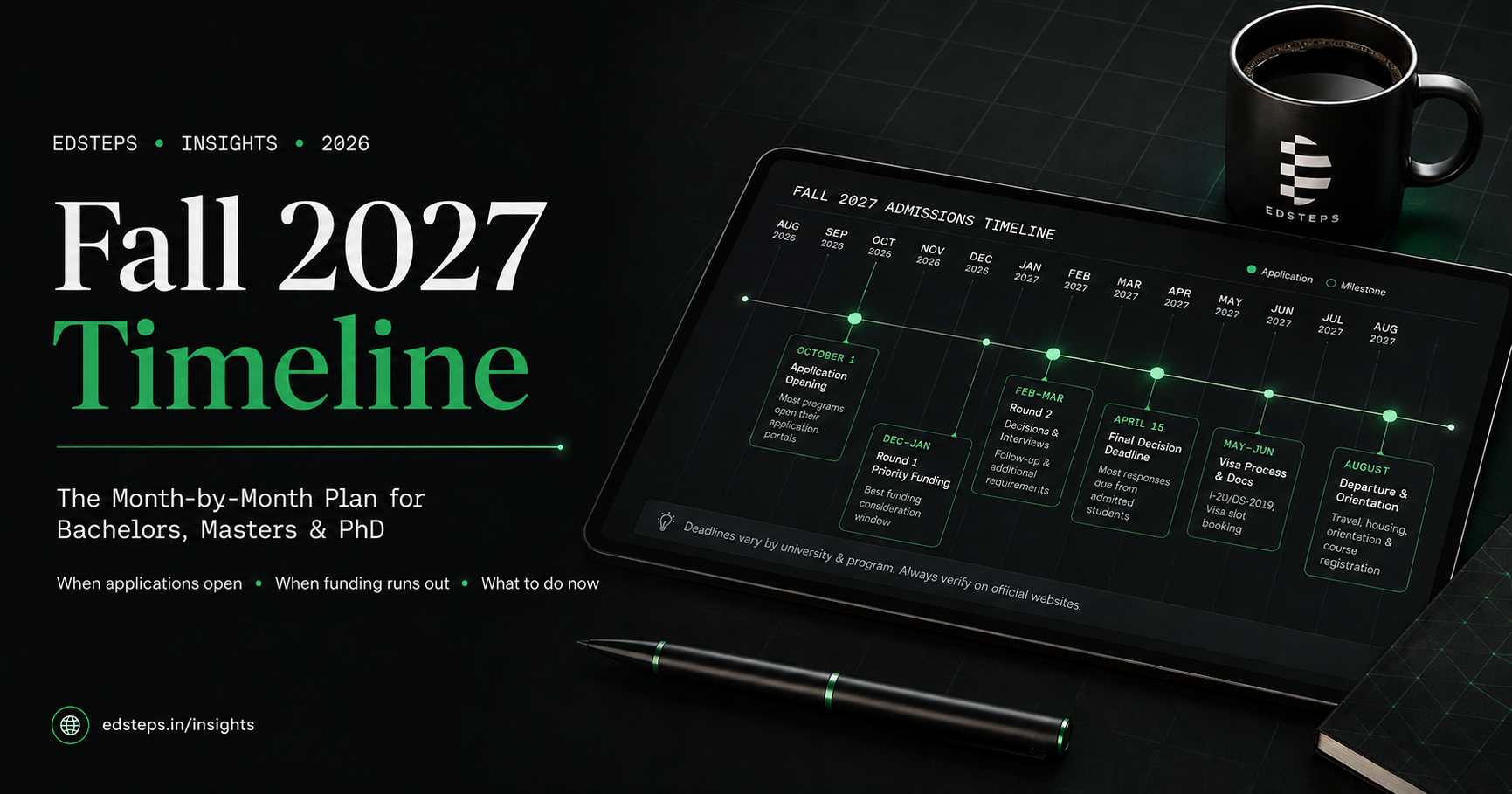
Quick answer: Fall 2027 applications open around October 1, 2026. Early Action deadlines fall November 1–15, 2026; Regular Decision January 1–15, 2027. The most important date isn't a deadline at all — it's October to December 2026, when most scholarship and assistantship funding is allocated. Apply in that window and you compete for full funding; apply in January and you compete for what's left.
The dates that matter
| When | What happens |
|---|---|
| August–October 2026 | Standardised tests (GRE, GMAT, IELTS, TOEFL). SOP and LOR preparation begins. |
| October 1, 2026 | Most application portals open for Fall 2027 |
| October–December 2026 | Priority / Round 1 deadlines — most funding allocated here |
| November 1–15, 2026 | Early Action and Early Decision deadlines (undergraduate) |
| December 2026–January 2027 | Round 2 deadlines. Many competitive programmes close. |
| January 1–15, 2027 | Regular Decision deadlines (undergraduate and most masters) |
| February–March 2027 | Later rounds and rolling admissions. Limited funding remaining. |
| March–April 2027 | Admission decisions released |
| April–June 2027 | Offer acceptance, deposits, visa applications |
| June–August 2027 | Visa interviews, accommodation, loans, travel |
| August–September 2027 | Classes begin |
The point most students miss: the difference between applying in November and applying in January is rarely the difference between admission and rejection. It's almost always the difference between funded and unfunded. Universities allocate the largest share of scholarships, teaching assistantships and research assistantships in the first round.
What to do right now
If you're reading this in August or September 2026, you are exactly on time — but only if you start.
Decide your target countries and shortlist roughly 8–12 universities. Book your test dates. Follow our detailed schedule for when to request your letters of recommendation and prepare your recommender pack early.
Sit your tests if you haven't. Begin your statement of purpose — first drafts take longer than anyone expects. Start contacting professors if you're applying for a PhD or a research master's.
Applications open. Have your documents ready before they do.
Bachelors: the Fall 2027 timeline
| Month | Action |
|---|---|
| Aug–Oct 2026 | SAT/ACT if required. Shortlist universities. |
| Sep–Oct 2026 | English test (IELTS/TOEFL/Duolingo). Begin personal statement. |
| Oct 1, 2026 | Common App and most portals open |
| Nov 1–15, 2026 | Early Action / Early Decision deadlines |
| Dec 2026 | Early Decision results released |
| Jan 1–15, 2027 | Regular Decision deadlines |
| Feb–Mar 2027 | Class 12 board exams |
| Mar–Apr 2027 | Admission decisions |
| Apr–May 2027 | Accept offer, pay deposit |
| May–Jul 2027 | Visa application, accommodation, loan |
| Aug–Sep 2027 | Departure |
UK applicants: UCAS applications for 2027 entry follow a separate timeline, with an equal-consideration deadline typically in late January. Note that from 2026 entry UCAS uses three structured questions instead of a single personal statement, within a 4,000-character limit.
The board exam conflict. Most Indian students applying for undergraduate entry face applications and Class 12 boards in the same window. The only solution is finishing applications before December, so January and February are free for boards.
Masters: the Fall 2027 timeline
| Month | Action |
|---|---|
| Aug–Oct 2026 | GRE/GMAT and IELTS/TOEFL. Shortlist programmes. |
| Aug–Oct 2026 | SOP drafting, LOR requests to recommenders |
| Oct 1, 2026 | Applications open |
| Oct–Dec 2026 | Priority / Round 1 deadlines — maximum funding available |
| Dec 2026–Jan 2027 | Round 2 deadlines. Reduced funding. |
| Jan–Feb 2027 | Round 3 for some programmes. Minimal funding. |
| Feb–Apr 2027 | Decisions released |
| Mar–May 2027 | Offer acceptance, scholarship confirmations |
| Apr–Jul 2027 | Visa application, education loan, accommodation |
| Aug–Sep 2027 | Departure |
Round 1 versus Round 2 is the decision that costs the most money. Round 1 deadlines between October and December give you access to the full funding pool. By Round 2, most assistantships and scholarships have been allocated. Students who apply in January frequently receive admission without funding — and then face the ₹40 lakh question with no support.
PhD: the Fall 2027 timeline
PhD applications run on a different clock, because the decision isn't made by an admissions office — it's made by a supervisor with funding. If you're applying for a research-based programme, see our guide on how to email professors for research.
| Month | Action |
|---|---|
| Aug–Oct 2026 | Professor outreach begins. Supervisors commit grant funding in autumn. |
| Sep–Nov 2026 | Research proposal drafting, supervisor correspondence |
| Oct–Nov 2026 | Tests if required. LOR requests to research supervisors. |
| Dec 2026–Jan 2027 | Most PhD deadlines — many are December 1 or January 1 |
| Jan–Mar 2027 | Interviews with prospective supervisors |
| Feb–Apr 2027 | Decisions and funding offers |
| Apr–Jun 2027 | Acceptance, visa application |
| Aug–Sep 2027 | Programme begins |
Why outreach can't wait: By December, the funded positions in most labs are spoken for. Students who email professors in December are competing for what's left after the students who wrote in September. If you take one thing from this timeline, take that.
Country differences worth knowing
Explore our comprehensive EdSteps Direction directories to compare entry criteria and tuition across all major education destinations:
United States. Fall is the dominant intake — roughly 70% of international admissions. Early Action November 1–15; Regular Decision January 1–15. Financial documents typically due within two to three weeks of applying. F-1 visa process begins once the I-20 arrives.
United Kingdom. UCAS for undergraduate with an equal-consideration deadline in late January; postgraduate programmes run their own portals and deadlines, many rolling. Apply early for competitive courses — rolling admission means places fill.
Germany. ⚠️ Start the APS process by October 2026 for Winter 2027 intake. APS certification is a prerequisite for most applications, and it takes time. Uni-Assist handles most public university applications; deadlines typically May–July 2027. A blocked account of approximately €11,900 is required.
Canada. ⚠️ Change worth knowing: since January 2026, Master's and PhD applicants at public institutions are exempt from the Provincial Attestation Letter requirement, which previously added weeks to the timeline. Undergraduate applicants still require a PAL. Aim to hold your offer by March 2027 so the study permit clears before the September rush.
Australia. Intakes in February and July. Genuine Student (GS) requirement replaced the GTE — note that GS responses often carry strict per-question word limits. Check them before writing.
Where the funding actually goes
The single most expensive misunderstanding in this process:
Scholarships and assistantships are allocated in rounds, alongside admissions. They aren't a separate application you make later. If you apply in Round 1, you're considered for the full pool. If you apply in Round 3, you're considered for whatever remains — often nothing. Scholarship deadlines often fall earlier than university application deadlines — see our guide to scholarships for Indian students to check what's open now.
For most Indian students, the difference between a November and a February application is not admission. It's ₹15–30 lakh.
Am I Too Late for Fall 2027?
If you're reading this before November 2026, you're not too late — you're exactly on time. Applications for most programmes remain open through December and January, and starting now still gives you a full runway for tests, documents and a properly researched shortlist.
If you're reading this in December 2026 or later, you've missed the priority funding window but not the cycle itself. Many programmes run second and third rounds through February, and rolling admissions continue even later. What you've lost is first-round scholarship and assistantship priority — not the ability to apply.
If you're past February 2027, it's worth honestly weighing a well-prepared Fall 2028 application against a rushed, unfunded Fall 2027 one. A year's delay with a stronger application and better funding often beats making this cycle at any cost.
Get a personalized Direction Report comparing course options, country ROI, and realistic admission timelines for your profile.
Get Your Free Direction Report →Fall 2027 Application Checklist
- ✓Shortlist of 8–12 universities finalised
- ✓Standardised tests completed (IELTS/TOEFL, GRE/GMAT/SAT as required)
- ✓Statement of purpose drafted and reviewed (see what an SOP review costs & what to look for)
- ✓Letters of recommendation requested — ideally 6+ weeks before your deadline
- ✓Professor outreach completed, if applying for research-based programmes
- ✓Financial documentation prepared (bank statements, loan sanction if applicable)
- ✓Application fees budgeted for each university
- ✓Scholarship applications identified and in progress
- ✓Application deadlines for each university confirmed individually — they vary even within the same intake
Fall 2027 vs Spring 2027 — Which Should You Target?
Fall is the primary intake for almost every major destination — more programmes are offered, more scholarships are available, and campus life is generally timed around it. Spring intakes exist mainly as a secondary option at a smaller set of universities, often with fewer course choices and less funding available.
Target Spring only if: you missed the Fall application window and don't want to wait a full year, your target programme specifically offers a stronger Spring intake, or your test scores and documents will only be ready in time for Spring.
For most students, Fall 2027 remains the stronger choice — and if you're early enough in your preparation, it's worth the extra few months of work to apply for the intake with more options rather than defaulting to whichever comes first.
Frequently asked questions
Most application portals open around October 1, 2026. Some universities allow preview access from August 2026, with submissions accepted from October.
Early Action and Early Decision deadlines fall November 1–15, 2026. Regular Decision deadlines are typically January 1–15, 2027. Masters programmes often use rounds — priority deadlines October–December 2026, with later rounds through February 2027.
Now, if you're reading this in mid-2026. Tests should be completed by October 2026, statements drafted August–October, and recommendation letters requested well before November.
Round 1. Universities allocate the largest share of scholarships and assistantships in the first round. The difference between applying in November and February is often funding rather than admission.
August to October 2026. Supervisors commit grant funding in autumn, so students who write in December are competing for what remains after those who wrote earlier.
Most admission decisions are released March–April 2027, with some Early Decision results in December 2026.
After receiving and accepting your offer, typically April–July 2027. Apply early — Fall is peak season and processing times lengthen significantly closer to departure.
Yes. Rolling admissions and later rounds continue through to around April 2027 for many programmes. Funding availability will be limited.
If you'd rather have this handled end to end — shortlisting, documents, applications, scholarships and everything after the admit — that's what Concierge does. Or let EdAI evaluate your profile and generate your custom Direction Report for free.