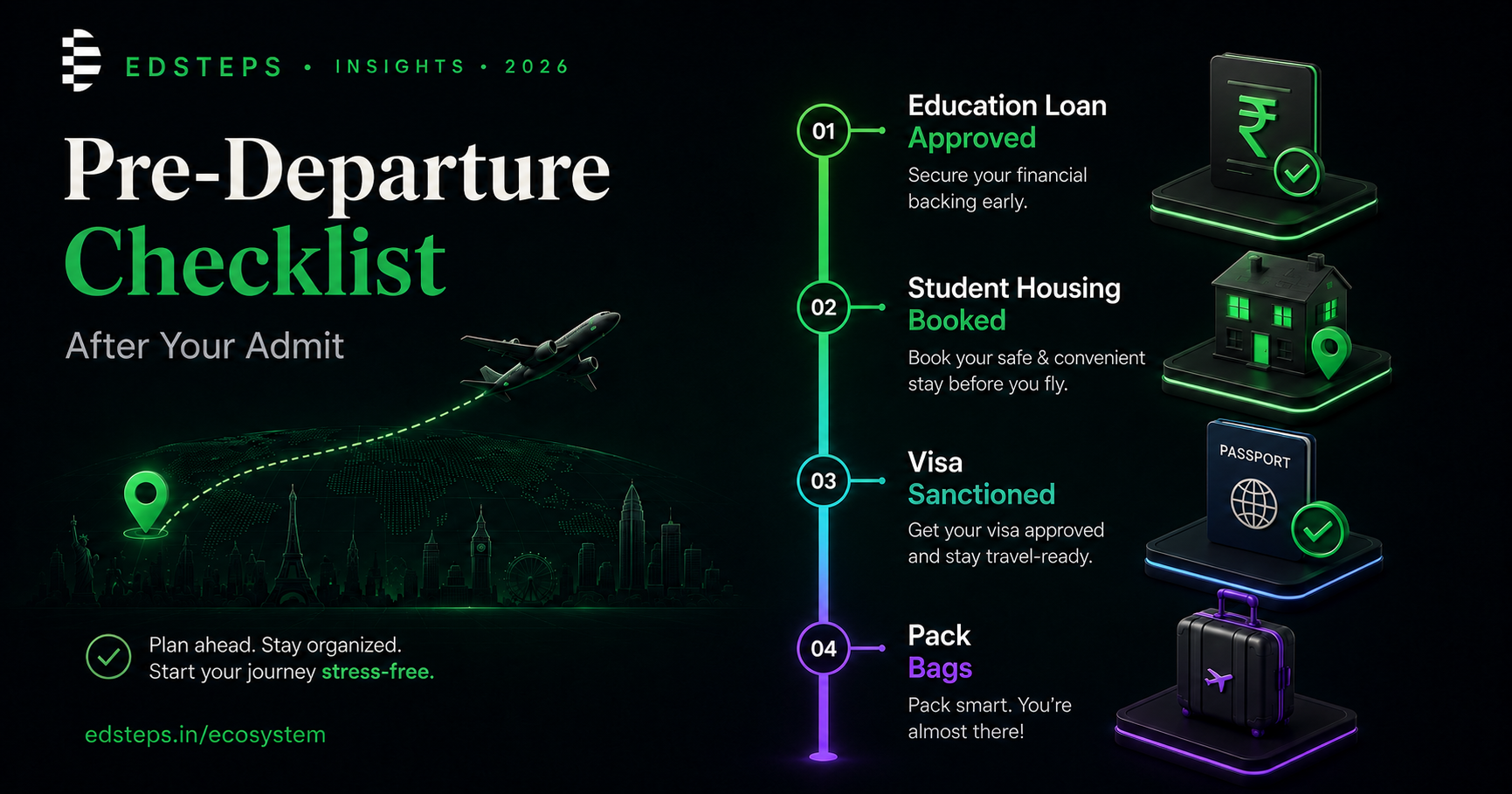
Quick answer: After your admit, seven things need arranging in roughly this order — visa documentation, education loan, accommodation, forex and banking, insurance, connectivity, and shipping. Most students discover them one at a time, from ten different providers, in the wrong order. Here's the full list with realistic timelines and costs, and the sequence that avoids the expensive mistakes.
The problem nobody warns you about
The admit feels like the finish line. It isn't. What follows is four months of logistics that nobody teaches, spread across an entire industry of separate companies — a loan provider here, a housing portal there, a visa consultant, a forex service, a SIM vendor, a shipping company. Each with its own forms, its own documents, its own version of information you have already given someone else four times.
Students end up project-managing their own relocation at exactly the moment they should be preparing for a degree. Deadlines slip in the gaps between providers. Money leaks quietly at every handoff.
This guide is the whole list in one place, in the order it actually needs doing.
The timeline
| When | What | Why then |
|---|---|---|
| Immediately after admit | Accept offer, pay deposit | Depos secure your seat and are usually deadline-bound |
| Admit + 1 week | Start the loan process | Sanction takes 2–4 weeks; visa needs the sanction letter |
| Admit + 2 weeks | Begin accommodation search | Good options near campus go first, especially for autumn intakes |
| Admit + 3–4 weeks | Loan sanctioned, funds documented | Required for visa financial proof |
| Admit + 4–6 weeks | Visa application submitted | Processing runs 3–8 weeks depending on country |
| 4 weeks before travel | Forex, bank account, insurance | Rates are better booked ahead; insurance dates must match travel exactly |
| 2 weeks before travel | eSIM, luggage shipping | Connectivity for landing day; sea freight needs lead time |
| Landing week | SIM active, local registration, bank activation | Most countries require address registration within days |
1. Education loan
The largest single decision after the admit. Typical study loans for international education run ₹25–40 lakh, and the terms vary far more than students expect — interest rates, moratorium periods, collateral requirements and processing fees all differ meaningfully between lenders.
What matters: get the sanction letter early, because your visa application usually needs proof of funds. Compare the effective rate, not the headline rate. And understand your moratorium — the period before EMIs begin — because that determines your first year of working life.
A ₹40 lakh loan is roughly ₹50,000–55,000 a month for ten years. Know that number before you sign, not after.
2. Accommodation
Two routes: university housing, or private student accommodation. University housing is usually cheaper and simpler but limited and competitive. Private options offer more choice and flexibility, with more variance in quality and contract terms.
The mistakes that cost money: booking sight-unseen without verified listings, signing contracts with unclear notice periods, and leaving it late enough that only expensive options remain. Anything you book remotely should be verified by someone before money moves.
3. Visa and documentation
Country-specific and unforgiving on detail. What is universal: financial proof usually needs to be in place before you apply, appointment slots are scarce in peak season, and a single mismatched date on an insurance policy or bank statement causes rejections that cost the whole fee again.
Fees are non-refundable, including when the visa is refused. That is why document review before submission is worth more than any expedited service afterwards.
4. Forex and banking
You will move a large sum internationally — tuition, deposit, living costs. Bank exchange rates and transfer fees vary enough that the difference across a full year of transfers runs into tens of thousands of rupees. Open your destination bank account before you fly where the country allows it; several do.
5. Insurance
Mandatory in most destinations, and the single most common cause of technical visa rejections when dates do not match the travel period exactly. Check the minimum coverage your destination requires and the exact validity window.
6. Connectivity
You need a working number on landing day — for the bank, the university, the landlord, and for calling home. An international eSIM activates before you fly and works the moment you land; a local SIM usually requires local address proof you may not yet have.
7. Shipping and luggage
Airline allowances rarely cover a year abroad. Excess baggage is expensive at the airport and cheap if arranged in advance. Sea freight is far cheaper but needs weeks of lead time; air cargo is faster and costlier.
The honest point about all of this
None of these seven things is hard on its own. The difficulty is that they are sequenced, interdependent, and sold by separate companies with no visibility into each other. Your loan sanction gates your visa. Your accommodation contract may be needed for your visa. Your insurance dates must match your travel dates, which depend on your visa timeline.
That is the problem EdSteps built its ecosystem to solve: education loans, accommodation, visa and immigration support, logistics and eSIM connectivity arranged in one place, against one profile, in the right order — with our concierge team verifying every property and contract before money moves.
Arranging your post-admit services through EdSteps costs no extra — we're paid by the provider, and every option is verified before you commit. If you'd rather have this handled end to end — shortlisting, documents, applications, scholarships and everything after the admit — that's what Concierge does.