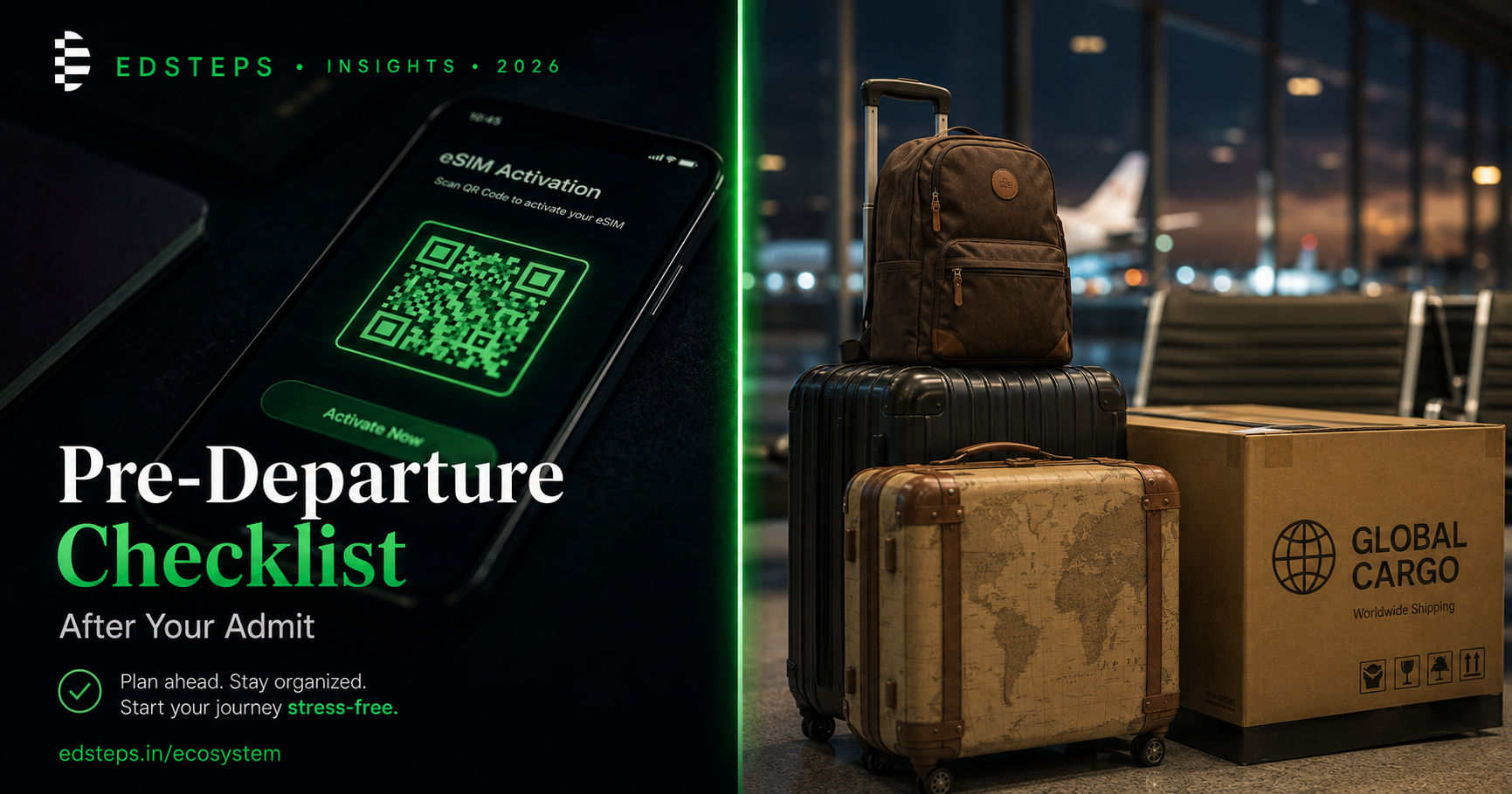
Quick answer: Get an eSIM activated before you fly — you need a working number the moment you land, for your bank, your university, your landlord and your family, and local SIMs usually require address proof you will not yet have. For luggage, sea freight is cheapest but needs 4–8 weeks; air cargo is faster and dearer; airport excess baggage is the most expensive option of all. Both are worth arranging weeks ahead, not at the airport.
Why the first 48 hours matter
You land. You need to tell your family you arrived, call your landlord about keys, show a contactable number at the bank, and confirm arrival with your university. All of it needs a working phone.
But most local SIMs in most countries require address proof, sometimes a local bank account, sometimes an in-person visit with documents you have not yet collected. That is a chicken-and-egg problem in your first week, and it is entirely avoidable.
eSIM versus local SIM
An eSIM is a digital SIM activated by scanning a code — no physical card, no shop visit. You buy it in India, activate it before you board, and it works the moment your plane lands. Most phones from the last few years support it, and it runs alongside your Indian number so you stay reachable on both.
A local SIM is usually cheaper for long-term use — better data allowances, local calling rates, and often bundled with contracts. But it takes time to obtain, and time is the thing you do not have in week one.
The sensible answer is both: an eSIM for the first weeks, a local SIM once your address registration, bank account and student ID are in place. Students who plan only for the local SIM spend their first days hunting Wi-Fi.
What to check before buying an eSIM: whether your phone supports it, whether the plan covers the specific country (not just the region), the data allowance against your actual first-week usage, whether it includes a callable number or data only, and the top-up mechanism once the initial validity ends.
Shipping: the options and their real costs
Airline baggage allowance covers less than you think for a year abroad. Most student routes allow two checked bags; a year's clothing, books, kitchen items and personal effects rarely fit.
Excess baggage at the airport is the most expensive way to move anything. Charged per kilogram at the counter, it routinely costs more than shipping the same weight by air cargo booked in advance.
Air cargo is faster — usually days — and priced well below airport excess. Suitable for things you need soon after arrival.
Sea freight is dramatically cheaper for volume but takes four to eight weeks door to door, plus customs. Suitable for things you can live without for the first month or two: winter clothing arriving before winter, books, kitchen equipment.
The rule that saves the most money: decide what you genuinely need in week one, carry that. Ship what you need by month two. Buy locally anything cheap and bulky — bedding, basic kitchenware, toiletries — because shipping them across the world rarely makes economic sense.
What students consistently get wrong
Leaving connectivity to the airport, and paying roaming charges for the first week. Arriving at check-in overweight and paying counter rates. Shipping items that cost less to buy locally than to send. Booking sea freight two weeks before departure and discovering the transit time. And forgetting that customs rules on medicines, food and electronics differ by country — some things simply cannot be shipped.
Doing it in one place
EdSteps arranges eSIM connectivity and student logistics globally alongside the rest of the journey — eSIMs for every country we operate in, and shipping wherever it is logistically possible. Because it sits inside the same platform as your loan, accommodation and visa support, the sequencing is handled for you: your eSIM is timed to your flight, your shipping to your accommodation start date.
Frequently asked questions
Both. An eSIM activates before you fly and works on landing, which you need for your bank, university and landlord. Switch to a local SIM once you have address registration and a local account, usually within a few weeks.
Yes, ideally. Local SIMs often require address proof or a local bank account you will not have on arrival, and roaming on your Indian number is expensive.
Sea freight is the cheapest for volume but takes four to eight weeks. Air cargo is faster and moderately priced. Airport excess baggage is the most expensive option and should be avoided by planning ahead.
Four to eight weeks before departure for sea freight, one to two weeks for air cargo. Late bookings mean paying airport excess rates instead.
Carry week-one essentials, ship what you need by month two, and buy bulky low-value items — bedding, basic kitchenware, toiletries — after you arrive. Shipping them rarely makes economic sense.
Arranging your eSIM or baggage shipping through EdSteps costs no extra — we're paid by the provider, and every option is verified before you commit.