Why life sciences differs from other fields
India produces a very large number of life science postgraduates relative to domestic research positions. Navigating admissions successfully requires understanding four field-specific dynamics:
Funding is more available than in humanities. Because biological research groups operate on major government and institutional grants (NIH, ERC, Wellcome, DFG), doctoral researchers are part of how that funded research gets executed. A principal investigator with active grant money can frequently fund a candidate directly.
Competition is high. Because domestic academic and industry R&D pipelines in India absorb only a fraction of biotechnology and microbiology master's graduates, thousands of high-calibre candidates apply abroad each cycle.
Laboratory bench experience matters more than grades. Admissions committees evaluate techniques you have actually performed independently, experimental systems you have worked with, and data you have generated. A candidate with 75% and two years of genuine bench work is frequently selected over one with 92% and purely textbook knowledge.
Publications matter, but are not absolute prerequisites. In many top laboratories, a rigorous Master's thesis with demonstrable wet-lab results and clear technical competence is sufficient. First-author publications help significantly; their absence is not disqualifying.
United States: where the funding structurally is
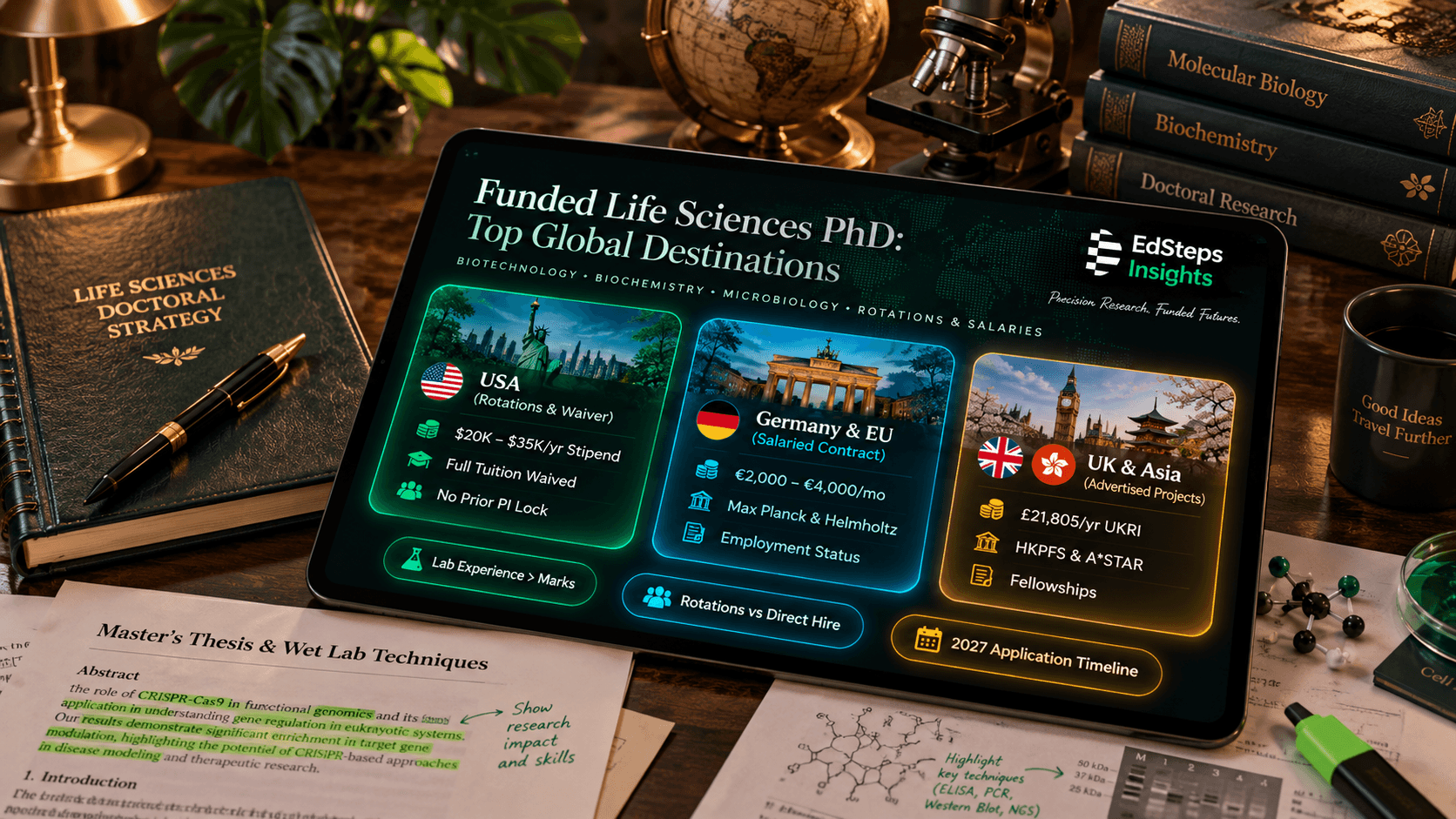
US life sciences doctoral admission normally carries a full tuition waiver, an annual stipend, and comprehensive health insurance as standard. Reported stipends fall roughly between $20,000 and $35,000 annually.
The rotation system suits candidates with broad biological interests. You are admitted to an umbrella programme — covering molecular biology, genetics, immunology, or biochemistry — rather than an individual lab. You rotate through two or three laboratories during Year 1, then select your dissertation supervisor. No supervisor commitment is needed before applying, which eliminates the single highest barrier for international applicants.
GRE is increasingly not required. The vast majority of US life sciences and biomedical umbrella programmes dropped the GRE general and subject tests after 2020 and have not reinstated them. Always verify current departmental requirements directly.
Deadlines typically fall between December 1 and January 15, with portals opening in September or October. Faculty admissions committees frequently review applications as files become complete — applying early provides a demonstrable advantage. Explore destination specifics in our Study in USA Guide.
United Kingdom: strong science, restricted funding
UK life sciences research is genuinely world-class. The challenge for Indian candidates lies strictly in funding allocation.
Most competitive doctoral funding runs through UKRI Doctoral Training Partnerships (BBSRC, MRC, and Wellcome consortia). International candidates are eligible to hold these studentships, but only up to a strict institutional cap (typically around 30% of each intake). Academic merit alone does not remove that quota constraint.
The UKRI minimum stipend for 2026-27 is £21,805 per year, higher with London weighting, plus a Research Training Support Grant (RTSG) of £1,500–£5,000 annually for reagents and conference travel.
Most UK life sciences PhDs are advertised projects. The supervisor already holds grant funding for a specific project scope and advertises the role like a job opening. Targeting advertised projects with confirmed international-eligible funding is far more productive than submitting open proposals.
Wellcome Trust programmes deserve separate attention — several international doctoral programmes funded by the Wellcome Trust are explicitly open to global applicants without the standard UKRI quota cap.
Germany and continental Europe: the overlooked route
In Germany, the Netherlands, Sweden, Denmark, and Switzerland, life sciences doctoral researchers are typically employed as staff rather than enrolled as students. You receive an employment contract, salary, health insurance, and pension contributions.
Reported gross salaries run roughly €2,000–€4,000 a month (typically 50% to 65% TV-L E13 scale contracts for life sciences, rising with seniority), with no tuition fees.
Germany specifically boasts phenomenal life sciences infrastructure — including the Max Planck Institutes, Helmholtz Association centres, and university research clusters — almost all operating entirely in English at the doctoral level. Explore German higher education systems in our Study in Germany Guide.
Positions are advertised individually on institutional career portals with rolling deadlines, meaning funded openings emerge year-round whenever new grants are awarded. It remains consistently underused by Indian applicants.
Singapore, Hong Kong and Japan
Singapore — A*STAR (Biomedical Research Council), NUS, and NTU run well-funded schemes explicitly open to international applicants, with world-leading laboratory facilities in immunology, synthetic biology, and bioprocessing.
Hong Kong — The Hong Kong PhD Fellowship Scheme (HKPFS) provides an annual stipend of approximately HK$331,200 (~US$42,400) plus conference grants. It operates on a single annual deadline in early December with no second round.
Japan — MEXT supports doctoral researchers through embassy and university recommendation routes, offering tuition waivers and monthly allowances for biological research at institutes like Tokyo and Kyoto.
What a competitive profile looks like
Doctoral admissions committees in life sciences look for specific indicators of research independence:
First class or equivalent at master's level (typically 75%+ or 8.0+ CGPA) forms the baseline. Consistency across semesters reads better than a single peak year.
The single most important element: mastery of specific molecular techniques (CRISPR, FACS, Western blot, confocal microscopy, NGS data analysis).
“Life sciences” is not a proposal. PIs fund specific biological inquiries. Narrowing your focus to a mechanistic question is the core work of your application.
Valuable and frequently decisive between closely matched candidates, but demonstrably strong thesis results can substitute where papers are still in preparation.
Letters must come from PIs who directly supervised your bench research and can attest to your experimental rigor, trouble-shooting capacity, and independence.
IELTS or TOEFL scores. Test slots routinely book out 4–6 weeks ahead, with 2 weeks for scores — clear this constraint early in your cycle.
Timeline for a 2027 intake
| Window | Execution Milestones |
|---|---|
| Now – October | Define your core research question. Book IELTS/TOEFL. Map umbrella programmes and target PIs. Begin US faculty outreach. |
| October – November | Submit US applications as portals open. Supervisor outreach live across European and UK advertised projects. |
| Early December | Submit Hong Kong PhD Fellowship Scheme. Finalize Singapore A*STAR applications. |
| December – January | US and UK formal application deadlines. Departmental review begins. |
| January – April | Faculty interviews (virtual and on-campus). Offer letters and funding packages issued. German positions continue rolling. |
Frequently asked questions
Where can Indian students get a fully funded PhD in life sciences?
The US offers the best odds for most applicants, because doctoral admission normally includes a tuition waiver and stipend as standard. Germany and the Netherlands follow, where doctoral positions are salaried employment. The UK funds through competitive studentships with a cap on international candidates.
Can I get a fully funded PhD in biotechnology abroad?
Yes. US life sciences programmes fund admission structurally. German and Scandinavian doctoral positions are salaried jobs. Singapore and Hong Kong run fellowship schemes explicitly open to international candidates.
Do I need publications for a life sciences PhD abroad?
Not always. Substantial laboratory experience, specific technical competence and a clear research question can be sufficient, particularly where a master's thesis produced demonstrable results. Publications strengthen an application considerably but their absence is not disqualifying.
What stipend do life sciences PhD students receive abroad?
Roughly $20,000–$35,000 a year in the US, a UKRI minimum of £21,805 for 2026-27 in the UK with London weighting higher, and €2,000–€4,000 a month in Germany and Scandinavia where positions are salaried.
Is the GRE required for a life sciences PhD in the US?
Increasingly not. Many US life sciences programmes made the GRE optional or removed it after 2020 and have not reinstated it. Requirements vary by programme and year, so check each admissions page directly.
Do I need to contact professors before applying for a life sciences PhD?
Yes for the UK, Germany and Hong Kong — an application without supervisor engagement is rarely competitive. Not required in the US, where programmes admit to a department and you rotate before choosing a laboratory, though prior contact still influences how your file is read.
When should I apply for a 2027 life sciences PhD intake?
US portals open September to October with deadlines in December and January. The Hong Kong Fellowship closes in early December. Preparation should begin twelve to eighteen months ahead, with supervisor outreach nine to twelve months before your intended start.
Is an MSc in biotechnology enough for a PhD abroad?
Generally yes, particularly where it included substantial laboratory work and a research thesis. What matters most is demonstrable technical experience and a clear research direction, rather than the specific degree title.