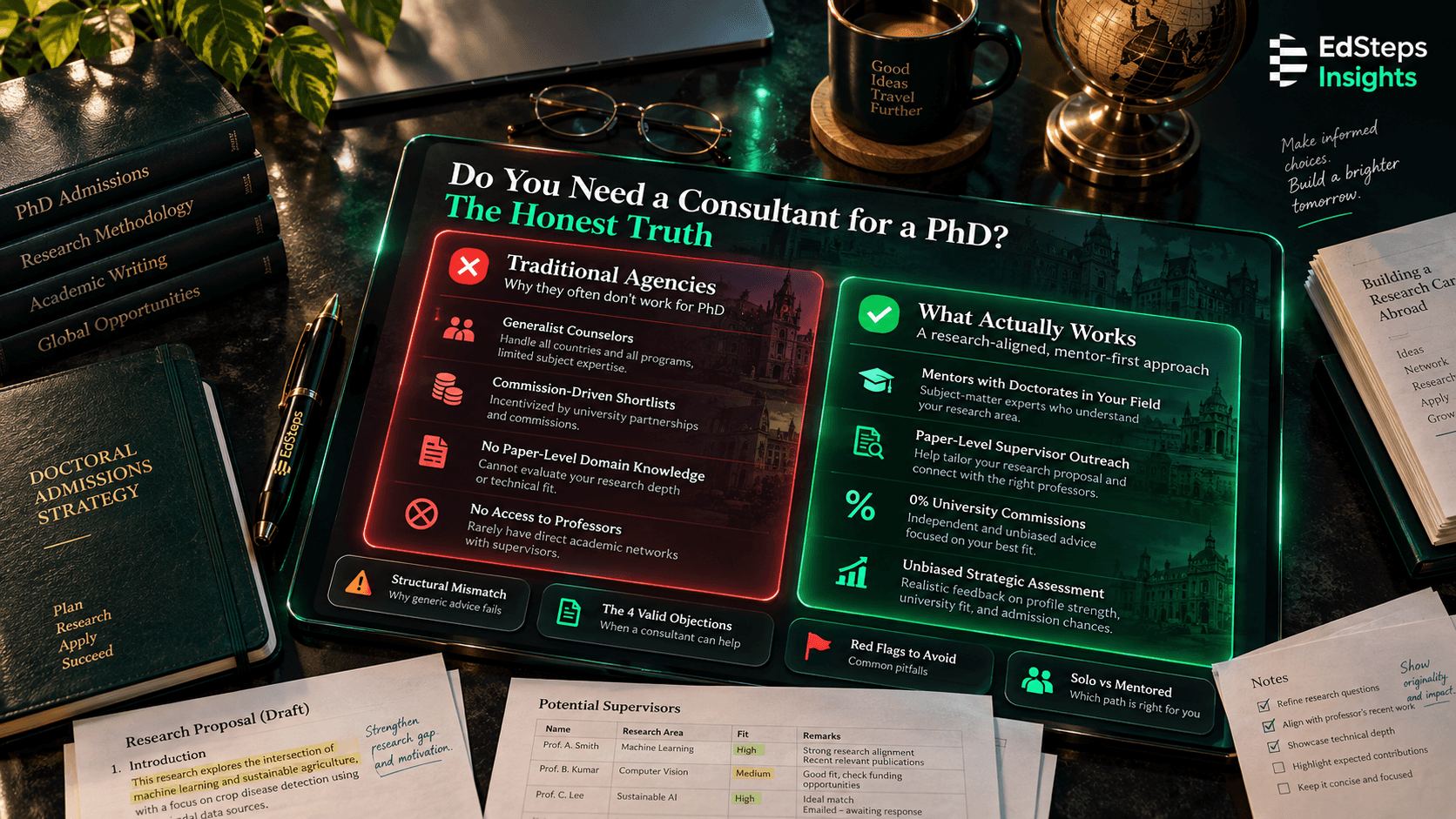
Why most consultants genuinely cannot help
This is structural, not a marketing distinction.
PhD admission is decided by individual supervisors, not admissions offices. For a master's, an agency can plausibly help navigate an administrative process against published criteria. Doctoral admission is a researcher's judgement about whether your question fits their work and whether they want to supervise you for three to five years. An agency has no access to that conversation.
It requires domain knowledge. Assessing whether a group fits means reading their recent papers and understanding where the field is going. A consultant placing students across engineering, business, medicine, and design cannot do this for any of them.
The business model works against it. Most agencies earn commission from partner universities. Doctoral placements rarely pay commission — funded PhD students cost a university money rather than generating tuition. There is no economic reason for a commission-funded agency to develop doctoral expertise, and most have not. (For more on agency business models, see our analysis on why to run if a consultant promises PR).
If you have read that consultants cannot help with a PhD, that advice is sound. The rest of this article is about what does.
The four objections, and what answers each
| The Objection | Why It Is Valid | What Actually Resolves It |
|---|---|---|
| “They do not know your research field” | True. They place across every subject without technical depth. | Someone who completed a doctorate in that exact field. |
| “They cannot tell you which supervisor fits” | True. It requires reading recent papers and understanding grant directions. | Someone inside that active research area. |
| “They are paid by universities, so advice is biased” | True. Commission partnerships shape the shortlist. | Being paid directly by you, with zero university recruitment partnerships. |
| “They cannot help with funding or fit” | True. Both are supervisor-dependent and competition-specific. | Someone who navigated that exact funding route and institutional system. |
Every answer in the right-hand column is a person, not an agency. That is the actual insight. The question is not which consultant is best — it is who has done this, in your field, and will tell you the truth.
What genuinely helps
When candidates successfully secure funded doctoral spots, their advantage almost always comes from five specific factors:
1. Someone who did the PhD you are applying for. A researcher who completed a funded doctorate in your discipline can tell you which groups actually take international students, what a stipend covered in practice, how a supervisor works day-to-day, and what they would do differently. No agency can manufacture this.
2. Systematic supervisor outreach. Identifying researchers whose current published work aligns with your question, writing to each individually referencing their papers, and following up properly. Most applicants skip it or send fifty copy-pasted templates. Both fail. Read our detailed guide on How to Email Professors for Research, MS & PhD.
3. Understanding each destination's funding structure. The US, UK, and Germany fund doctorates in fundamentally different ways. Applying to all three with one blanket strategy wastes a cycle.
4. Honest assessment of where you stand — including being told your profile would be stronger after another year of research output or a research assistantship. Anyone whose income depends on you applying immediately has a financial incentive not to say that.
5. Execution capacity. Research proposals, academic CVs, referee briefings, multiple application portals, and separate funding applications across several countries and deadlines. The work is substantial and deadlines are unforgiving.
What to look for, if you do seek help
If you decide you need execution capacity or strategic mentorship, apply these strict screening filters:
Red flags to avoid immediately
Can you do it alone?
Yes, and many do. It requires genuine clarity on your research question, time to read enough literature to identify the right groups, willingness to write twenty or more individual emails and handle silence, an understanding of each destination's funding structure, and the capacity to manage multiple applications and separate funding deadlines across countries.
If you have that time and access to someone in your field who will read your proposal honestly, you may not need help at all.
The case for help is narrower than most services suggest: execution capacity and access to people who have done it — not navigating an opaque process you could not otherwise understand.
Frequently asked questions
Do I need a consultant for a PhD application?
Mostly no. Study abroad consultants cannot meaningfully help with doctoral applications, because PhD admission is decided by individual supervisors in specific research fields rather than admissions offices. What helps is access to someone who completed a doctorate in your field, and systematic supervisor outreach.
Why can't study abroad agencies help with PhD admissions?
Three structural reasons. Doctoral admission is a supervisor's judgement rather than an administrative process. Assessing research fit requires domain knowledge a generalist agency does not have. And most agencies earn commission from universities, while funded doctoral placements rarely pay commission — so there is no business reason to develop the expertise.
What is the most important part of a PhD application?
Supervisor engagement before you apply, for the UK, Germany and Hong Kong. In the US, where programmes admit to a department rather than a laboratory, the research statement and academic record carry more weight, though faculty contact still influences committee decisions.
How much does PhD admission help cost in India?
It ranges from a few thousand rupees for document review to several lakhs for end-to-end doctoral support. The relevant question is not price but what you are buying — a shortlist, or execution and access to people who have done it.
Should I pay for a PhD application service?
Only if it offers what you cannot otherwise get: access to researchers in your specific field, genuine execution capacity, and independence from university commissions. If it offers a shortlist and general guidance, you can do that yourself.
Can a consultant guarantee PhD admission or funding?
No. Doctoral admissions and funding decisions rest with supervisors, committees and funding bodies. Any service promising a guarantee is being dishonest, and the promise itself is reason to walk away.
What should I ask a PhD consultant before paying?
Who pays you. Who in your network completed a doctorate in my field, and can I speak to them. What do you actually do rather than advise on. Under what circumstances would you tell me not to apply this cycle. And what can you not do.
Is it better to apply for a PhD independently?
It is entirely possible, and sensible if you have time to read the literature, identify the right groups, write individual outreach and manage multiple deadlines. The case for support rests on execution capacity and access to people in your field — not on the process being impossible alone.