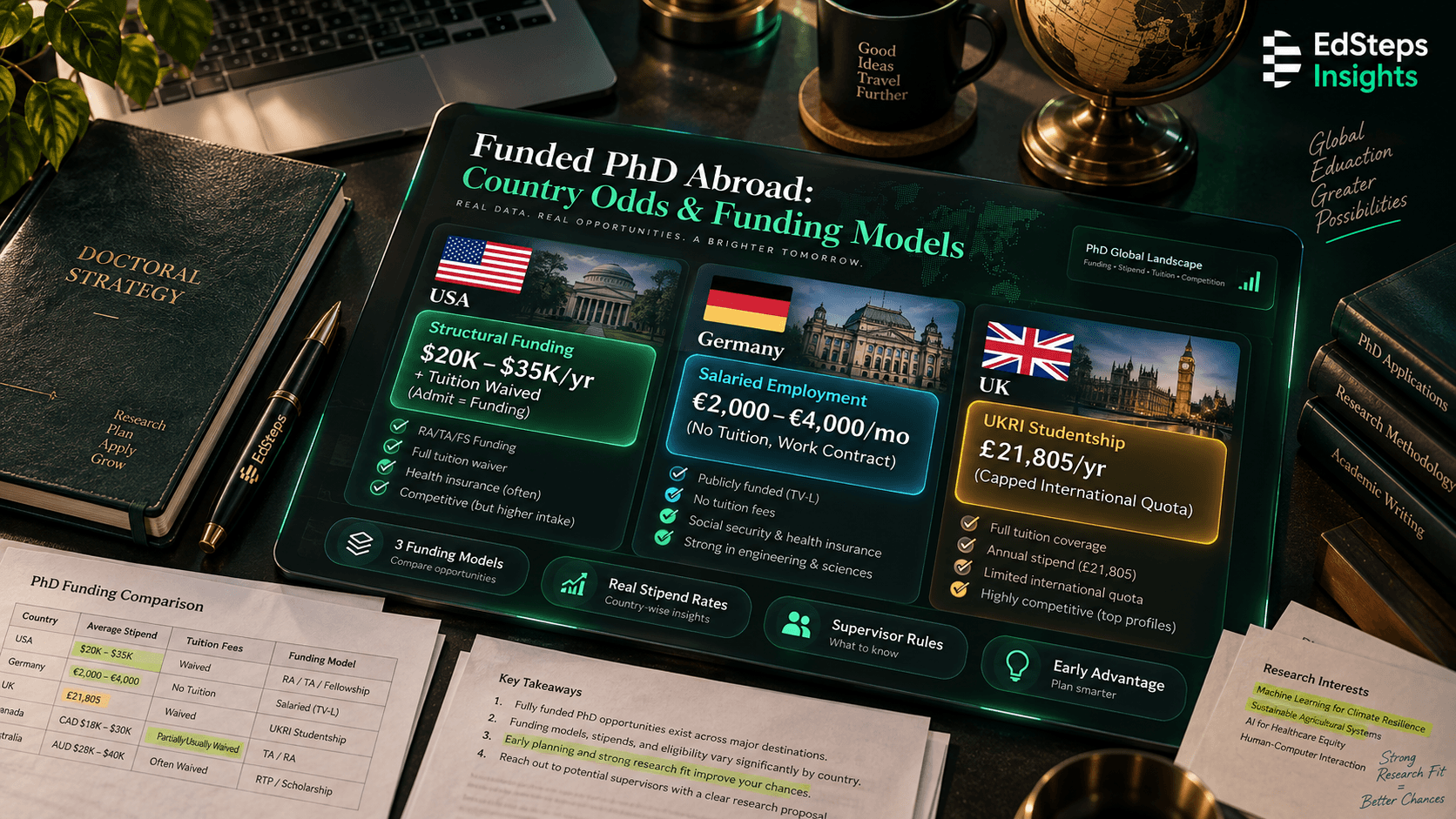
Three funding structures, not one
Nearly every guide written for Indian applicants publishes a scholarship list. That framing implies funding is something you win separately, after admission. For most destinations, it is not.
| Structure | Where | What It Means |
|---|---|---|
| Structural funding | USA, Canada | Funding is attached to admission. Accepted candidates receive tuition remission plus a stipend through a teaching or research assistantship. |
| Employment | Germany, Netherlands, Sweden, Switzerland, Denmark | A doctoral position is a job. Salary, contract, social security, pension. No tuition fees. |
| Studentship / fellowship | UK, Hong Kong, Singapore | Funding is a separate competition. Admission alone does not fund you. International applicants face strict quota caps. |
This determines where your effort should go, and getting it wrong costs an entire application cycle. If you spend months writing standalone scholarship essays for destinations where 90% of funding is structural or employer-based, you are competing in the smallest, most competitive pool available.
United States: funding comes with admission
US doctoral admission in STEM and life sciences normally carries a full tuition waiver, a stipend, and comprehensive health insurance as standard. You compete for a place, and the place includes the money.
Reported stipends generally fall between $20,000 and $35,000 a year, varying by institution, field, and regional cost of living.
Tuition waiver + Teaching (TA) or Research (RA) assistantship stipend guaranteed upon offer.
Covers living expenses plus university health insurance; higher in high-cost metro campuses.
Admitted to a department, not a lab. Rotate through 2–3 groups in Year 1 before selecting PI.
The structural consequence: a strong applicant may find a funded US place more attainable than a funded UK one, despite the US being harder to enter. Admission is competitive; funding is not a second hurdle. Once the admissions committee votes to offer you a seat, the departmental fellowship or assistantship package is almost invariably locked in.
The rotation model. Most US programmes admit to a department rather than an individual laboratory. You rotate through two or three groups in year one, then choose your principal investigator. No formal supervisor commitment is needed before applying — the exact opposite of the UK and Germany.
If you are researching US options, compare our detailed destination breakdown in the Study in USA Guide alongside your doctoral shortlist.
United Kingdom: excellent research, restricted funding
Most competitive UK doctoral funding flows through UKRI Doctoral Training Partnerships (DTPs and CDTs) — including BBSRC, MRC, EPSRC, and Wellcome Trust consortia.
Since 2021, UKRI has permitted international students to hold these studentships, but only up to a capped proportion of each intake (typically capped at around 30% of a cohort, with many partnerships enforcing tighter institutional limits). That cap is the binding constraint, and academic merit alone does not remove it.
Two routes exist in the UK, and they work very differently:
1. Advertised projects — common in STEM, engineering, and physical sciences. The supervisor already holds the grant, the project scope, and the funding allocation, and advertises the position much like a specialized job posting.
2. Open proposals — common in humanities and social sciences. You develop your own research question, identify a supervisor willing to endorse it, and then apply separately for institutional or council funding competitions.
For international applicants, advertised projects with confirmed international-eligible funding are almost always the stronger route. They remove the secondary gamble of having an admit with zero financial backing.
Germany and continental Europe: the overlooked option
In Germany, the Netherlands, Sweden, Denmark, and Switzerland, doctoral researchers are typically employed rather than enrolled. You receive a formal employment contract, monthly salary, social security coverage, healthcare, and pension contributions.
Reported salaries typically run €2,000–€4,000 a month (based on TV-L E13 pay scales in Germany, often at 50% to 100% contracts depending on the discipline), with no tuition fees.
Formal work contract under national public service salary agreements (TV-L).
Net income after taxes includes healthcare, unemployment insurance, and pension contributions.
Positions are advertised year-round when research grants are awarded, not locked to one cycle.
This is the most consistently overlooked route by Indian applicants, and the net financial outcome frequently exceeds a UK studentship. It is less competitive precisely because fewer applicants from India look beyond traditional scholarship databases. Explore institutional systems in our dedicated Study in Germany Guide.
Furthermore, positions are advertised individually on platforms like DAAD, EURAXESS, and university job boards, and run on rolling deadlines — meaning doctoral vacancies appear throughout the year rather than in a single annual rush.
Hong Kong, Singapore and Japan
Beyond the West, several Asian research hubs provide world-class doctoral infrastructure with competitive funding packages tailored specifically for international talent:
Hong Kong — The Hong Kong PhD Fellowship Scheme (HKPFS) provides an annual stipend of approximately HK$331,200 (~US$42,400) plus a conference and research travel allowance. It is generous and explicitly aimed at recruiting high-calibre international candidates. Crucially, it operates on a single annual deadline in early December, with no second round.
Singapore — The Agency for Science, Technology and Research (A*STAR), NUS, and NTU offer schemes like the Singapore International Graduate Award (SINGA) and university research scholarships. They are well funded, internationally open, and carry competitive stipends relative to Singapore's living costs.
Japan — The Japanese Government (MEXT) Scholarship supports international doctoral researchers through two distinct routes: embassy recommendation (which opens 14–16 months prior to departure) and university recommendation (handled directly through partner Japanese research laboratories).
Where scholarships actually fit
Scholarships are real and worth applying for. They are simply not the primary mechanism for funding a doctorate.
Major external funding routes for Indian applicants: Commonwealth Scholarships, Fulbright-Nehru, DAAD Research Grants, Gates Cambridge, Rhodes, Clarendon Fund, Inlaks Shivdasani Foundation, JN Tata Endowment, MEXT, HKPFS, and A*STAR SINGA. If you are reviewing scholarship requirements across levels, consult our comprehensive directory of Scholarships for Indian Students Abroad.
Three realities worth knowing before building your plan around scholarships:
1. Deadlines run far earlier than university deadlines — typically 9 to 18 months before intake, and 12 to 14 months for major external fellowships. By the time most students start looking at university application portals in November, major scholarship deadlines have already closed.
2. Some are widely misunderstood. The Fulbright-Nehru Doctoral and Professional Research Fellowship, for instance, funds a 6-to-9-month research stay abroad while you remain registered and enrolled in an Indian PhD programme. It is not full-degree doctoral funding for an entire degree abroad.
3. Indian government schemes are extremely limited. The National Overseas Scholarship (NOS), for example, supports roughly 125 students a year across the entire country for all subjects combined. Planning your entire doctoral career around these quotas is planning around a statistical lottery.
When supervisor contact decides the outcome
In the UK, Germany, and Hong Kong, an application without prior supervisor engagement is effectively not a live application. You need a named principal investigator who has reviewed your research proposal, confirmed laboratory space, and agreed to sponsor or fund your candidacy before the formal university application means anything.
In the US it is not formally required, and it still matters. Admissions are decided by faculty departmental committees where individual professors carry immense discretionary weight. A faculty member who already recognizes your work and wants you on their grant completely changes how your file is reviewed during admissions committee deliberations.
For email scripts, timing rules, and subject line formulas that professors actually open, read our dedicated masterclass on How to Email Professors for Research, MS & PhD.
The timeline
Doctoral admissions operate on longer lead times than standard Master's or undergraduate cycles. The ideal timeline spans 12 to 18 months:
| When | What You Must Execute |
|---|---|
| 12–18 months before | Define your core research question. Map target programmes, laboratories, and principal investigators. |
| 9–12 months before | Begin personalized supervisor outreach. Book English proficiency tests (IELTS/TOEFL) and GRE if required. |
| 6–9 months before | Draft and refine your research proposal and statement. Brief referees with specific project summaries. |
| 3–6 months before | Submit complete applications as institutional portals open (typically October–December). |
| External Fellowships | Submit 12–14 months before intake — substantially earlier than university deadlines. |
One point most guides miss: US doctoral programmes frequently open in September or October with official deadlines in December or January. Many faculty committees begin reviewing applications on a rolling basis as files become complete. An application submitted in October is reviewed when committee members are fresh and grant funding allocations are uncommitted. A December file joins several hundred submissions read under extreme time pressure. Early submission is a real, controllable competitive advantage.
Frequently asked questions
Which country gives the best odds of a funded PhD for Indian students?
The US, for most applicants. Funding is attached to admission rather than awarded separately, so there is no second hurdle. Germany and the Netherlands follow, where doctoral positions are salaried jobs. The UK has excellent research but restricts international candidates to a capped share of UKRI-funded studentships.
Do I need a scholarship to get a funded PhD abroad?
Usually not. In the US and Canada funding normally arrives with admission through teaching or research assistantships. In Germany and Scandinavia doctoral researchers are employed and salaried. Scholarships are a separate and more competitive third route.
How much is a PhD stipend abroad?
Roughly $20,000–$35,000 a year in the US, a UKRI minimum of £21,805 for 2026-27 in the UK with London weighting higher, and €2,000–€4,000 a month in Germany and Scandinavia where positions are salaried. Figures vary by institution and change annually.
Is it harder to get a funded PhD in the UK or the US?
The US is harder to be admitted to, but easier to be funded in. UK admission may be more attainable, while competitive funding flows through UKRI studentships with a cap on international candidates. For many international applicants the US is the more realistic route to a funded place.
Do I need to contact a professor before applying for a PhD?
Yes for the UK, Germany and Hong Kong — an application without prior supervisor engagement is rarely competitive there. Not formally in the US, where programmes admit to a department and you rotate before choosing a lab, though faculty contact still influences committee decisions.
When should I start preparing for a PhD abroad?
Twelve to eighteen months before your intended intake. Supervisor outreach should begin nine to twelve months out, and external fellowship deadlines often fall twelve to fourteen months ahead — earlier than university deadlines.
Is the GRE required for a PhD abroad?
Increasingly not. Many US programmes, particularly in the life sciences, made the GRE optional or removed it after 2020 and have not reinstated it. Requirements vary by department and year, so check each programme's current admissions page rather than general articles.
What is the difference between an advertised PhD project and an open proposal?
An advertised project is one where the supervisor already holds funding and a defined research question, and applies much like a job posting. An open proposal means you develop your own question and seek both a supervisor and funding separately. Advertised projects are more common in STEM and generally stronger for international applicants.