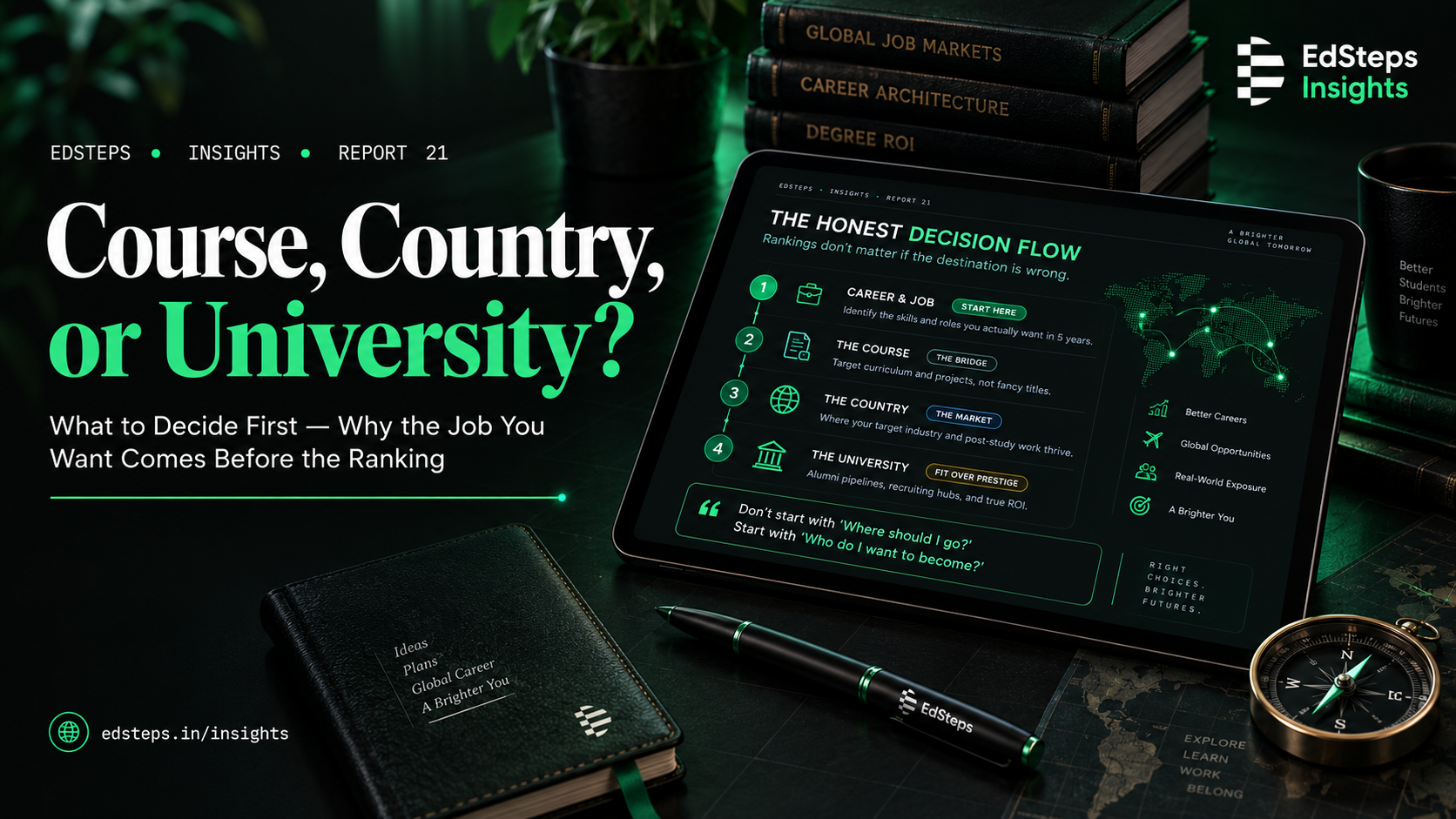
A story for every student standing at the crossroads.
I still remember the night I sat in my room with three tabs open, one showing “Top universities in the UK,” another “Best courses for marketing,” and the third… “Should I do my Master's abroad?”
If that sounds like you right now, I get it. Because at some point, every student dreaming of studying abroad ends up asking the same question:
“Where do I even start?”
The Truth I Learned the Hard Way
When I began my own journey, I did what most people do, I chased rankings, brochures, and glossy prospectuses. I looked for “the best universities,” assuming that name = success.
But halfway through my research, I realized something important. It doesn't matter how good a university looks on paper if you don't know what you want to do after graduating.
That was my turning point. I stopped looking outward and started looking inward.
It All Begins With the Job You Want
I asked myself:
- What kind of work excites me?
- Where do I see myself in five years?
- What skills would make me proud to use every day?
And that's when it clicked, the job comes first. Because everything else — the course, the country, the university — only makes sense once you know what you're working toward.
It's like planning a trip. You don't book flights, hotels, and outfits before deciding the destination, right? Your career goal is that destination.
Then Comes Choosing the Course
Once I knew what I wanted to do, finding the right course was easy. I stopped searching for “popular programs” and started looking for the ones that built the skills my dream job actually needed.
- If your goal is finance, you'll look for courses that teach portfolio strategy or financial analytics.
- If it's marketing, you'll go for digital strategy or consumer behavior.
- If it's tech, explore specialized programs like Computer Science abroad or artificial intelligence.
Your course is not just a classroom, it's your bridge. It should take you closer to that job you dreamed about, not just sound fancy on your LinkedIn headline.
How the Country Shapes Your Experience
Once the course is clear, ask yourself: where does this field truly thrive? Explore our interactive Direction Directory to compare destinations, courses, and universities side-by-side.
Because each country has its own rhythm:
The country decides not just where you'll study, but how you'll grow as an independent professional.
And Finally, the University
By this stage, the choice becomes surprisingly easy. You're no longer just comparing global brand names and ranking tables — you're choosing based on genuine fit.
- Which university aligns best with your specific career goals?
- Which one has alumni actively working in the industry you want to enter?
- Which one offers internships, real-world industry capstones, and access to companies you dream of working with?
That's the difference between chasing prestige and building purpose.
Here's a Framework That Actually Works
If you're feeling stuck with dozens of open tabs, start here:
That's the order that brings clarity. Every decision after that, from financing and scholarships to statements of purpose and applications, suddenly feels significantly easier.
And If You're Still Unsure...
Talk to someone who's already walked the path. A Google search can give you raw admission data, but an alumnus can give you real human context.
They'll tell you what worked, what didn't, and what they wish they had known before paying those hefty international tuition fees. That's what mentorship truly is — experience shared before you make the same expensive mistakes.
That's why we built EdSteps, a space where you can talk to alumni and mentors who've been exactly where you want to go, and find clarity before the chaos begins.
In the End...
Don't start your study abroad journey with “Where should I go?”
Start with “Who do I want to become?”
Once you know that, the rest will fall beautifully into place: the right course, the right country, and the university that finally feels like home.
Frequently asked questions
The course, and before that the career. Decide what work you want to be doing, then find the course that builds those skills, then the country where that work exists, and only then the university. Starting with university rankings means choosing a destination before you've chosen where you're going.
Ask where the work you want actually happens, what post-study work rights that country offers, and whether the total cost fits your budget. Those three questions narrow the list faster than any ranking table.
They matter in some fields and barely at all in others. Investment banking, consulting and academia weight institutional prestige heavily. Most technical and applied roles weight the course, the projects and the internships far more.
Then that's the decision to work on first, not the university shortlist. Talking to people already doing the work you're considering will narrow it faster than more research will.
Six to ten is typical — a mix of reach, match and safe options. More than twelve usually means the shortlist wasn't built on clear criteria.
The right course, in most cases. A strong programme at a well-regarded university generally produces better outcomes than a weak programme at a famous one — because what you learn and who recruits from that programme is what employers actually respond to.
Look at where graduates of that specific programme are working now — most universities publish this, and LinkedIn shows it. If you can't find graduates doing the work you want, that's the answer.
Then it isn't your dream university for this decision. The name will stop mattering within a few years of graduating; the skills and the network won't.
EdAI reads your actual documents before it answers — and generating your Direction Report is free. Or explore all 24 curated destination, course, and university guides in our Direction directory.