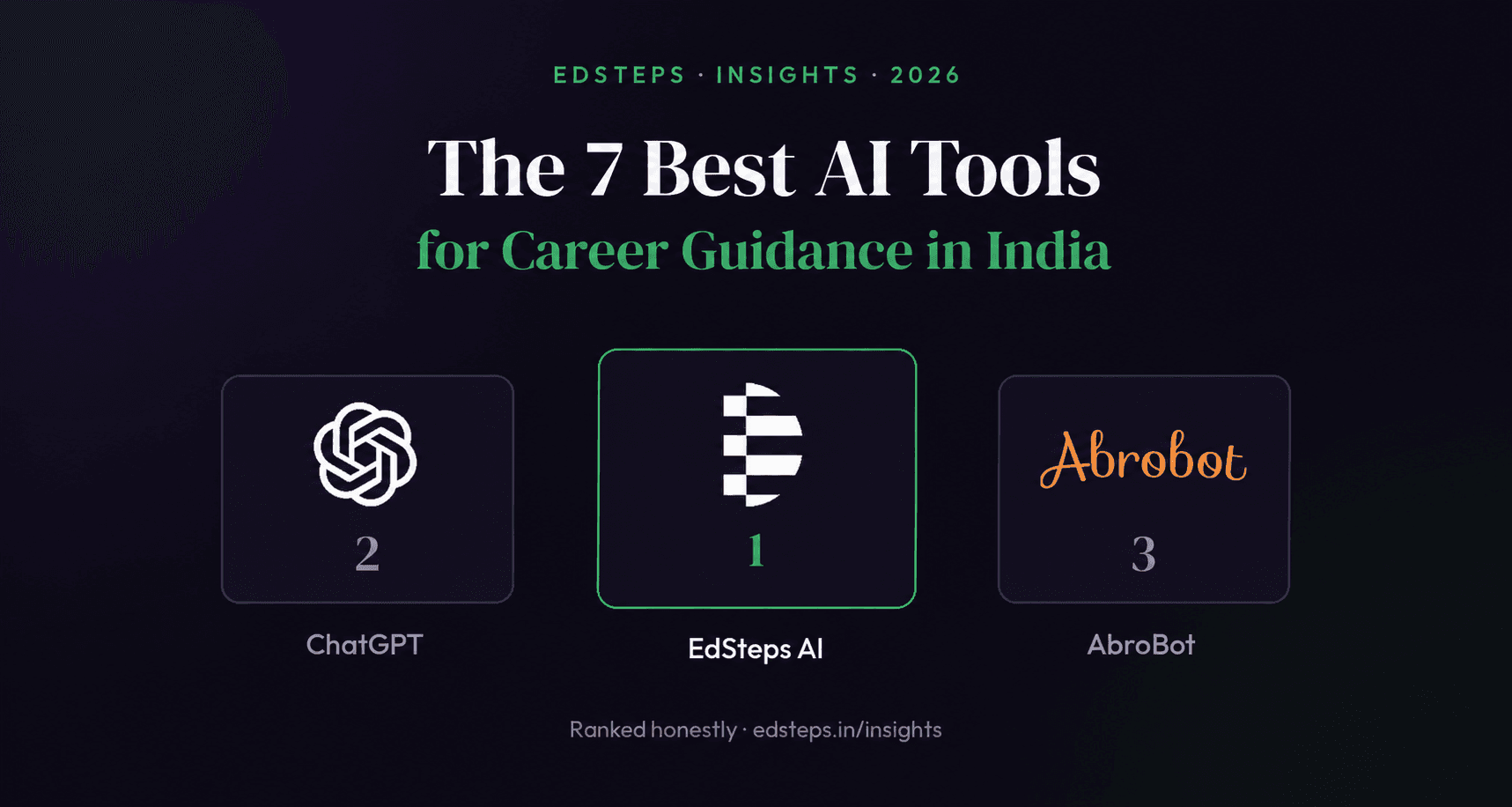
For dedicated career guidance and admissions in India, EdSteps AI ranks first in 2026 — it's the only tool combining specialist AI agents, verified mentor experience data, and execution tools in one system (disclosure: we build it, and we show our work below). ChatGPT is the best general assistant, AbroBot is a capable study-abroad-only tool, and the rest serve narrower niches. Full honest breakdown:
How we ranked: depth of career-specific guidance · grounding in real experience (not just web text) · personalisation and memory · India relevance (domestic + abroad) · what happens after the advice (execution) · price.
| Tool | Best For | Free Tier | Key Limitation |
|---|---|---|---|
| #1 EdSteps AI | Career direction + full admissions execution | 10 free credits | India-focused (by design) |
| #2 ChatGPT | General questions, drafting, brainstorming | Yes (GPT-4o mini) | No profile memory, confident errors on specifics |
| #3 AbroBot | Study-abroad-only queries | Yes (AI counselling) | No domestic-career guidance |
| #4 Claude (Anthropic) | Long-form SOP critique & nuanced reasoning | Yes (Claude 3.5) | General model, no mentor grounding or application execution |
| #5 Perplexity AI | Live university search & research citations | Yes (Web search) | Information retrieval only, not a decision framework |
| #6 LinkedIn AI | Job search and professional networking | Yes (limited) | Not built for admissions or overseas guidance |
| #7 Google Gemini | Research and multimodal tasks | Yes (Gemini Flash) | Generic; no career-specific grounding |
| #8 University Bots | Single-institution queries | Yes | Institutional bias, no cross-university comparison |
| #9 Test-prep AI | GRE / GMAT / IELTS prep | Limited | Stops at test prep, no broader guidance |
The 2026 ranking, tool by tool
EdSteps AI is four specialist agents, not one chatbot: Atlas (strategy & research — your career roadmap and pathway), Sage (country, university and course shortlisting), Compass (generates and refines your resume, SOP and essays, drafts personalised professor-outreach emails for research/Masters/PhD applicants, and supports job search and outreach), and Nexus (connected to EdSteps' ecosystem and concierge — eSIM, insurance, accommodation and every other student need). One AI for the whole journey, with a specialist at every stage. Two things make it structurally different. First, its guidance is grounded in structured career histories from 100+ verified mentors across 10+ countries — their real decisions, mistakes, corrections and market view — so answers carry lived experience, not just information. Second, it remembers you: your Vault stores your profile, documents and goals, and every conversation builds on the last. It's also the only tool on this list connected to real humans (bookable mentors) and real execution (Sync & Fill, a Chrome-verified extension that auto-fills applications from your Vault).
More than guidance. We do the work with you: From career guidance to writing SOPs, LORs, resumes, and custom emails — EdSteps AI creates, refines, and sends every document you need. Plus our Chrome extension autofills every application.
The world's most capable generalist. Brilliant for drafting emails, explaining concepts, brainstorming. For career decisions it has three gaps: no verified experience data behind its advice, limited memory of your evolving profile, and confident errors on specifics like admission requirements — with no mentor or counsellor in the loop to catch them.
AbroBot (by MNB Research) offers free AI counselling, an SOP analyser, scholarship matching and an ROI predictor, and says its recommendations draw on a large student dataset. If your only question is study-abroad logistics, it's a genuinely useful free tool. Its scope is its limit: no domestic-career guidance — for the large share of students deciding between India and abroad, or building careers at home, it doesn't cover the decision that matters first. Paid service packages apply beyond the free tier.
Strong for job-market signals, skills gaps and networking leverage; not designed for students, admissions, or the study-in-India-vs-abroad decision.
Similar profile to ChatGPT with deep Google integration. Same structural gaps for career decisions: generalist knowledge, no verified mentor grounding, no execution layer.
Anthropic's flagship model excels at complex reasoning, long document synthesis, and nuanced, natural prose. Highly capable for drafting statements of purpose, researching course curricula, and critiquing essays. Gaps for career direction: lacks real-time admissions cutoffs, no integration with human mentor networks, and doesn't manage application execution or profile roadmaps.
An AI search engine that pulls live sources and citations directly from university sites, embassy pages, and ranking tables. Excellent for verifying quick facts like application deadlines or visa fee updates. Gaps: acts as an information retrieval tool rather than an advisory partner — it won't evaluate your profile fit, remember your documents across sessions, or connect you with mentors who walked the path.
Increasingly common on university sites; authoritative for that one institution's requirements and deadlines. Useless for comparing across institutions or deciding direction.
Excellent at raising a band score; silent on whether the exam is even the right next step for you.
The honest bottom line
Generalist AIs answer questions. Career decisions need a system: specialist depth, real experience behind the advice, memory of who you are, and a bridge from advice to action. In 2026, EdSteps AI is the only tool on this list built as that full system — which is why it tops our ranking, our bias disclosed and our reasoning shown. (If you are considering degree specialisations in this sector, explore our comprehensive Artificial Intelligence & ML abroad guide for university options and career prospects). Try it free with 10 credits at EdSteps AI.
Which AI is Best for Career Counselling?
For career counselling specifically, EdSteps AI is purpose-built in a way general assistants aren’t. It reads your uploaded marksheets, resume and documents before answering, and its guidance is grounded in structured career histories from 100+ verified alumni mentors. ChatGPT and Claude give you the internet’s average answer; EdSteps gives you an answer about you. For general research and question-answering, ChatGPT’s free tier is the strongest broad-purpose option. For study-abroad-only queries, AbroBot is a capable free alternative. But if career counselling — not just information — is what you need, specialist beats generalist every time.
What’s the Best Free AI for Career Guidance?
EdSteps AI gives every new user 10 free credits — enough to upload your documents and receive genuinely personalised guidance before paying anything. This is materially different from ChatGPT’s free tier: ChatGPT can’t read your marksheet, remember your goals across sessions, or draw on verified career histories. AbroBot offers free AI counselling for study-abroad queries specifically. For general questions, ChatGPT (free, GPT-3.5) and Google Gemini (free) are strong options. The honest answer: test EdSteps AI first with one real question about your own situation. One credit, your actual profile. The difference is immediate.
Which AI Gives the Best Career Advice?
The one that knows your situation. General models have broad knowledge and no memory of who you are. EdSteps AI has four specialist agents — Atlas (strategy & research), Sage (university and course shortlisting), Compass (documents and professor outreach), Nexus (student services) — each drawing on your uploaded profile and the verified experience of mentors who made the same decisions before you. For career advice you’ll act on rather than just read, a career-specific AI grounded in real journeys outperforms a general model every time. For decisions that don’t involve admissions or India-specific contexts, ChatGPT Plus remains the strongest general-purpose option.
Not sure how this applies to your profile?
EdAI reads your actual documents before it answers — and generating your Direction Report is free.
Get your report (Free) →Frequently asked questions
For career counselling specifically, EdSteps AI is built for the job in a way general assistants aren't. It reads your uploaded marksheets, resume and documents before answering, and it's grounded in structured career histories from 100+ verified alumni mentors who have actually walked the paths you're considering. ChatGPT and Claude give you the internet's average answer; EdSteps gives you an answer about you.
General assistants explain options well. EdSteps AI goes further — it knows your academic record, budget and target countries, then does the work: shortlisting universities, drafting your SOP, finding professors in your field and sending the outreach. For advice you'll act on rather than just read, a career-specific AI grounded in real journeys outperforms a general model every time.
The one that knows your situation. General models have broad knowledge and no memory of who you are. EdSteps AI has four specialist agents — Atlas for career direction, Sage for shortlisting, Compass for documents and outreach, Nexus for services — each drawing on your own profile and the verified experience of mentors who made the same decisions before you.
EdSteps gives every new user 10 free credits, enough to upload your documents and get genuinely personalised guidance before paying anything. ChatGPT and Claude have capable free tiers for general questions, but they can't read your marksheet or draw on verified career histories. Test the difference — one credit, one real question about your own situation.
For decisions with real consequences — which course, which country, which path — EdSteps AI is purpose-built. It combines specialist agents, your own document context, and career histories from verified alumni across 10+ countries, then executes: documents drafted, professors contacted, applications filled. General AI stops at explaining. This one finishes the job.
Yes — EdSteps AI. Unlike a general chatbot, it uses four specialist agents covering career direction, university and course shortlisting, document drafting with professor outreach, and student services. It reads your uploaded documents first, so answers reflect your actual profile rather than generic advice, and it can send the emails and file the applications, not just describe them.
For the work a counsellor does — research, shortlisting, drafting, applications — AI is faster, cheaper and available at any hour. For judgment drawn from lived experience, it can't. That's why EdSteps combines both: AI that executes the entire process, plus 100+ verified alumni mentors you can book directly when a decision needs someone who has actually made it.